Marketing teams don’t experiment with artificial intelligence on the side anymore. AI now executes nearly every task on a marketing team’s calendar. Be it drafting ad copy or deciding which customer sees which offer at which price.
This guide breaks down what the use of AI in digital marketing actually involves. It walks you through the technologies powering it, and lays out how marketers are putting it to work today. It also covers where the risks are, so you can weigh the upside against the trade-offs before committing budget or headcount to it.
Key Takeaways
- 75% of marketers now use AI for various marketing tasks.
- Despite high adoption, majority of marketing teams still run generic campaigns that produce no meaningful results.
- Generative AI can reduce production time. It makes content generation 90% faster than manually producing the same.
- AI can personalise offers at scale. Its specially valuable since 71% of internet users expect personalized marketing communication.
- AI agents can handle multi-step tasks, such as selecting an audience, adapting campaign messages, and recommending the next action.
- AI can draft and repurpose content faster. People still need to check its facts, originality, and tone.
- Predictive AI can flag likely churn, demand, or high-value leads. Poor data makes those predictions less reliable.
- AI can speed up SEO research and content planning. Marketers still need to check search intent, expertise, and relevance.
- AI can optimise ads faster, but inaccurate conversion data may teach it to pursue low-value leads.
- Review AI output before customers see it. An unchecked ad could invent a feature, price, or discount.
- Clean data matters more than more data. Remove duplicates and fix outdated records and incorrect conversion signals.
- Check rights before publishing AI-generated assets. Use licensed or brand-owned material and review the tool’s commercial terms.
- Put practical safeguards in place: approve public content, protect customer data, verify claims, and monitor live campaigns.
- Start with a measurable problem, such as slow reporting, weak targeting, or customer churn.
- Keep people in control of strategy and final approvals while AI handles repetitive analysis and production.
What is the role of AI in marketing?
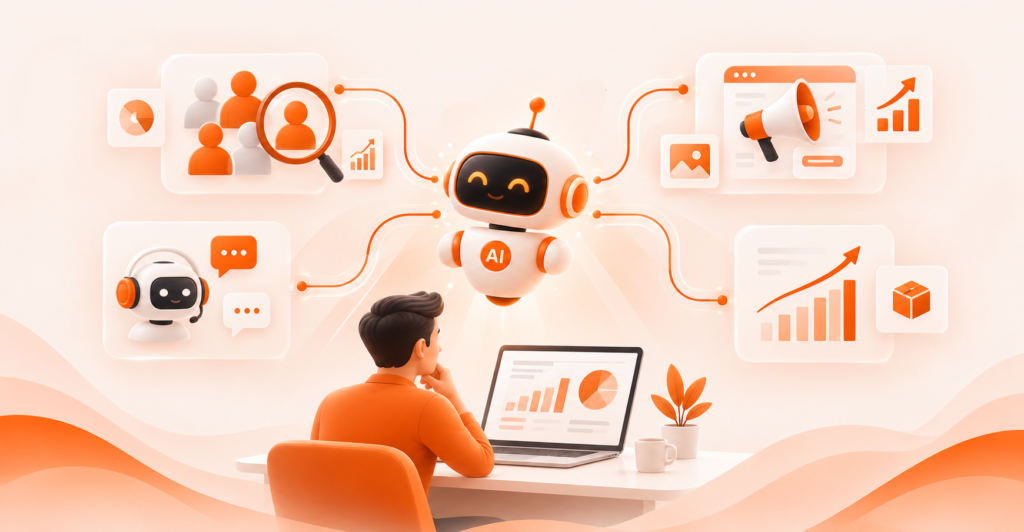
The role of AI in digital marketing is to automate repetitive tasks, surface patterns in customer data that a person would take weeks to find manually, and generate content and recommendations at a scale no team could match on its own.
Rather than replacing marketers outright, it changes where their time goes. It does so by shifting effort away from execution and toward strategy, judgement, and creative direction. Now AI’s role in marketing has expanded in value and importance:
- AI can execute audience segmentation by grouping customers by using purchase behaviour to make campaigns more relevant.
- Ad platforms can adjust bids and test creative using campaign performance data.
- Chatbots can answer customer queries and pass complex requests to a person.
- Predictive models can use past sales and current demand to help teams plan stock.
Not every team is at the same point on that curve. Some marketers still treat AI as a single tool bolted onto one task, such as a copywriting assistant or a chatbot widget.
Others have built entire workflows around AI. For instance, in content marketing, an AI content automation agent can move an approved brief through outlining, drafting, search checks, and CMS publishing. with editors reviewing the work before it goes live.
Similarly, in campaign management, models can help teams decide what to test, whom to target, and when to intervene. In both cases, decisions draw increasingly on a brand’s own data while people retain final judgment.
Top AI technologies
Three categories of technology account for most of what falls under AI in marketing today. Agentic systems that act on their own toward a goal, established marketing platforms with AI layered into features marketers already use, and generative tools built specifically to produce content. Most marketing stacks now run a mix of all three rather than relying on just one.
Agentic Systems
| What are agentic systems for marketing? | Tools built to pursue a goal across multiple steps without a person prompting each one individually. Instead of answering a single question, an agentic system plans a sequence of actions, executes them, checks the outcome, and adjusts before moving on. |
| What do agentic systems for marketing do? | Agentic AI in marketing is used for multi-step processes like building an audience segment, drafting an outreach sequence, sending it, watching how people respond, and re-engaging anyone who didn’t, all without a marketer triggering each step by hand. |
| Some examples of agentic AI in marketing | Salesforce Agentforce coordinates agents across marketing, sales, and service on top of a company’s own CRM data. HubSpot Breeze runs content, prospecting, and customer agents natively inside HubSpot’s hubs. Albert.ai manages paid media buying on its own across Google, Meta, and programmatic channels. |
AI-powered Marketing Tools and Platforms
| What are AI-powered marketing tools? | The marketing automation, CRM, and analytics platforms teams already relied on before generative AI existed, now rebuilt with models threaded through their core features rather than sold as a separate add-on. |
| What do these tools and platforms do? | They handle send-time optimisation, lead scoring, dynamic audience segmentation, automatic bid adjustments across ad channels, and campaign reporting that flags an anomaly before a person would spot it on a dashboard. |
| Some examples of AI-powered Marketing Tools | Klaviyo applies predictive analytics to time email and SMS sends around when a subscriber is statistically most likely to buy. Google’s Performance Max adjusts bidding and creative combinations in real time across Search, Display, and YouTube. Semrush layers AI into keyword research and content scoring for SEO teams. |
Generative AI tools for content creation
| What are generative AI tools | Tools built specifically to produce text, images, video, or audio from a prompt, rather than to manage a campaign or hold a customer record. |
| What they do | They draft blog posts and ad copy, generate product photography and social graphics, and produce voiceover or avatar-led video without a studio shoot, cutting the gap between a brief and a finished asset from days to minutes. |
| Generative AI Examples | Jasper generates on-brand marketing copy trained on a company’s existing content and style guide. Midjourney and Adobe Firefly produce campaign imagery from text prompts. Synthesia turns a script into an avatar-led video for training or explainer content. |
How to use AI in marketing?
Using AI in marketing well starts with picking one function where data or repetition is the real bottleneck, testing a tool against a clear metric, and expanding only once it proves it moves that number.
Aggressive measures to overhaul the complete marketing process never work out. Targeted application is the right way and these are the areas in marketing that any business can improve using AI:
Content marketing
AI shortens the distance between a blank page and a workable draft. Marketers use it to generate outlines, produce first drafts of blog posts and social captions, and repurpose a single long-form piece into a dozen smaller assets for different channels. What it doesn’t do well on its own is originality: a model can only recombine patterns it has already seen, so the ideas, the specific stories, and the judgement about what’s worth saying still need to come from a person. Brands that skip that step tend to end up with content that reads as competent but forgettable, which erodes trust with an audience faster than publishing less often would.
AI in marketing example
Coca-Cola’s Create Real Magic platform, built with OpenAI and consultancy Bain & Company, invited the public to remix the brand’s own archive of imagery using DALL-E and GPT rather than producing every asset in-house. The initiative generated more than 120,000 unique pieces of consumer-made artwork, drew over 316 million media impressions across placements including Times Square and Piccadilly Circus, and registered 90% positive sentiment. It’s a useful reference point for how a legacy brand can hand its creative assets to AI, and to its own audience, without diluting what makes the brand recognisable.
Personalisation
Personalisation is where AI moves from producing content to shaping the experience around an individual customer. Instead of segmenting an audience into broad groups, models can adjust a product recommendation, an email subject line, or the layout of a landing page for each visitor based on their browsing history, past purchases, and stated preferences. Customers increasingly expect this level of relevance by default, and the gap between a brand that delivers it and one that still sends the same message to everyone has become a competitive difference rather than a nice extra.
AI in marketing example
Sephora built its Virtual Artist tool using computer vision to let shoppers try on shades of lipstick, foundation, and eyeshadow through their phone camera before buying, addressing one of the hardest problems in beauty retail: customers can’t physically test a product online. The company paired it with Skincare IQ and Fragrance IQ, assistants that route recommendations based on a shopper’s stated skin type and preferences. These efforts produced a meaningful lift in online sales and repeat purchase.
Predictive analytics
Predictive analytics uses historical and real-time data to estimate what might happen next: which customers may cancel, how much stock a store could need next Tuesday, or which leads deserve a sales team’s attention. The value comes from acting early. A team can reorder stock before it runs out, contact an at-risk customer, or adjust a media budget before performance falls further.
An AI analytics agent is an example in action. It can help by monitoring connected data, flagging emerging risks, and recommending where the team should act.
AI in marketing example
Starbucks built its Deep Brew platform to forecast food and beverage demand in 30-minute windows at each store, rather than relying on a manager’s estimate, factoring in local weather, foot traffic, and past sales patterns. The finer-grained forecasting cut food waste at participating stores by an estimated 15 to 20%, while the same platform powers the personalised offers sent through the Starbucks Rewards app based on a customer’s order history.
Search engine optimisation (SEO)
AI is changing both how marketers do SEO and how people find answers. It can group related keywords, draft content briefs, and flag technical issues across thousands of pages, helping teams identify work that would take much longer to review manually.
Search results are changing too. AI-generated summaries answer some queries directly, so visibility now includes whether these engines cite your brand in those answers. To see how often your brand appears compared with competitors, measure your AI brand presence. If competitors appear more often, an answer engine optimization services can help you identify which topics and sources need attention.
Advertising campaigns
In paid media, AI mostly shows up as automation working behind the scenes: adjusting bids in real time, testing dozens of creative combinations against different audience segments, and reallocating spend toward whichever version is converting.
However, the more visible use is generative. AI turns a single campaign concept into dozens of personalised variants. It is something that would have been financially impossible to produce by hand.
AI in marketing example
Lumen Technologies, a B2B networking company, used generative AI for its “Waves” campaign. Its marketers created messages for different buyer roles and industries, then adapted the approved creative for LinkedIn, Meta, and display ads.Lumen cut the time needed to produce four Meta ad variations for two buyer personas by 65%. The example shows how AI can speed up tailored ad production while the team still sets the message and approves the work.
Challenges of using AI in marketing?
The three biggest challenges marketers face are 1) generic content when AI produces it without human oversight, 2) copyright concerns when models use or generate material that resembles existing work, and unreliable outputs when the system relies on 3) poor-quality or incomplete data.
AI-Slop
AI-slop refers to content that lacks quality and impact. Bland phrasing, interchangeable structure between articles, and false claims, are tell-tale signs of AI-slop.
It tends to appear when teams treat volume as the goal rather than a means to an end, publishing more than they can realistically review. Audiences notice the pattern quickly, and search engines have started penalising it too, which means the shortcut it offers is often temporary at best.
Copyrighted material
A marketer who publishes an AI-generated image or passage without checking how closely it resembles existing work risks a takedown, a licensing dispute, or reputational damage well after the campaign has already run.
The reason behind this issue is simple. Generative models are trained on enormous datasets that include copyrighted text, images, and code, and the legal question of what a brand is allowed to do with output derived from that training data is still being settled in courts around the world.
Low Quality Data
A predictive model or personalisation engine is only as good as the data it learns from. Incomplete customer records, outdated purchase history, or data that overrepresents one segment of an audience will all produce recommendations that feel off, or worse, actively alienate the customers a campaign was meant to reach. This problem tends to stay invisible until a campaign underperforms and someone traces the issue back to the dataset it was built on.
How to deal with these challenges?
Most of these risks are manageable with a few standing rules rather than a major overhaul.
- To minimise AI-slop, have an editor verify claims, add firsthand examples, and remove content that offers no value.
- Copyright risks call for licensed or brand-owned source assets, a review of the vendor’s commercial-use terms, and a check for recognisable similarities in the final work.
- To deal with poor-data quality, marketing teams must fix duplicate customer records, outdated information, and incorrect conversion events before models can use the data for personalisation or forecasting.
- Choose transparent AI vendors. Prefer providers that are clear about how their models were trained, and use licensed or brand-owned image and video sources for customer-facing work where possible.
- Put simple safeguards in place early. Teams can manage most risks with a few standing rules rather than a major process overhaul, and those checks take far less time than correcting a public mistake later.
What are the benefits of using AI in marketing?
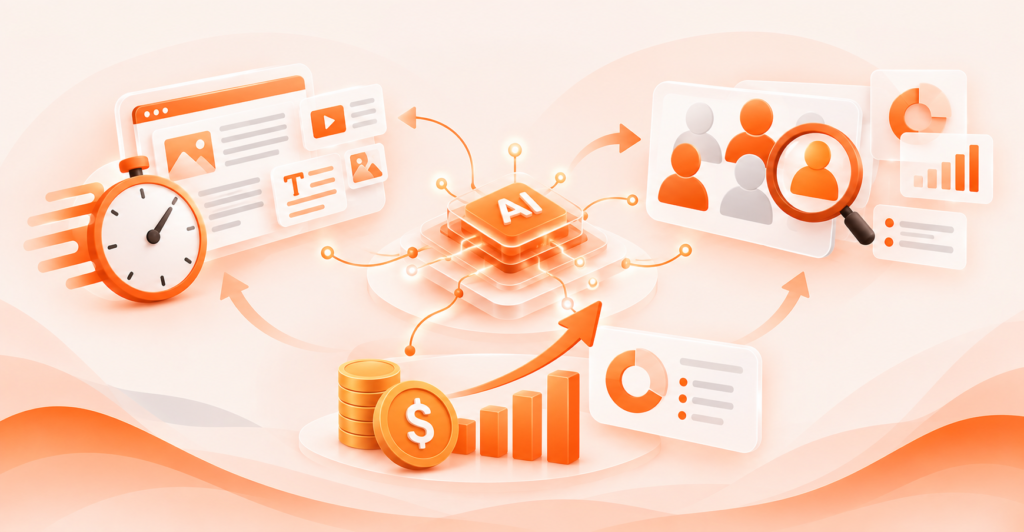
AI in marketing pays off in three main ways.
- It compresses timelines that used to take days into minutes
- It reduces the number of people required to complete routine and repeatable tasks
- It lowers the cost of producing and testing marketing material at scale.
Fast
A content draft, a data analysis, or a full set of ad variants that used to take a team days can often be produced within the same afternoon. That speed matters most when a campaign needs to respond to something happening in real time, whether that’s a trending topic, a competitor’s move, or a sudden shift in how an existing campaign is performing.
Reduction in Human-resource requirement
Tasks that once needed a dedicated person watching a dashboard or manually tagging data can now run with far less oversight. This doesn’t necessarily mean fewer marketers on a team; more often it means the same team can take on more work, since the routine parts no longer consume the hours they used to.
Cost-effective
Producing and testing marketing material at scale used to mean paying for a proportional amount of production time. Generating a hundred ad variants to find the one that resonates costs a fraction of what commissioning a hundred manual variants would, which lets even smaller marketing budgets run the kind of testing that was previously reserved for larger ones.
Winning Strategies for Marketing in the Age of AI
To get useful work from AI, give it the same context and checks you would give a new member of your marketing team:
- Give it real customer context. If you ask GPT to draft a win-back email, tell it which customers the email is for, what they bought, and why they stopped engaging. Use an approved audience summary rather than uploading raw customer records.
- Give it your brand materials. Provide the tone of voice guide, current product information, approved offers, and examples of past campaigns. A prompt that says only “write a promotional email” will give it little to work with.
- Review the final message. Before sending that email, check the offer, price, product claims, links, and tone. AI may write confidently about a discount that has expired.
- Use AI where work gets stuck. If turning one campaign into email, social, and ad copy takes too long, test AI on those adaptations. Give it the approved campaign message so each version stays consistent.
- Check whether the test helped. Compare the time taken and the performance of the AI-assisted campaign with your usual process. For a lead campaign, look at qualified leads, not just clicks.
- Start AI agents with a limited task. An agent could check campaign results each morning, flag ads losing qualified leads, and draft changes for a marketer to review. Let it recommend changes first; require approval before it edits ads or moves budget.
Final Words
AI hasn’t replaced the fundamentals of good marketing: knowing an audience, saying something worth saying, and backing decisions with evidence. What it has done is remove a lot of the manual work standing between a marketer and those goals. But that advantage comes with new risks that need new rules for effective execution.
AI can make content production, targeting, and analysis faster, but generic output, unclear rights to creative assets, and poor customer data can undermine the results. The way forward is to use AI for defined marketing goals, check what it produces, and measure what improves. The Hyperminds brings marketing strategy, AI agents, and search visibility work together to help brands put that approach into practice. If you are ready to make AI a useful part of your marketing, partner us to thrive in the age of AI.
FAQs
How can AI improve customer segmentation in marketing campaigns?
AI can group customers by purchase history, browsing behaviour, and engagement instead of relying only on broad demographics. Marketers can then tailor offers to each group, such as sending a win-back campaign to customers likely to leave. Check that customer records are current and that each segment is large enough to test before using it in a campaign.
What are the top AI-powered platforms for content generation in marketing?
Useful options include ChatGPT for briefs and copy drafts, Jasper for content guided by brand voice, Adobe Firefly for visual assets, and Canva Magic Studio for campaign designs. The best choice depends on the asset you need to produce; every customer-facing result still needs an accuracy, rights, and brand review. OpenAI
What are the key benefits of using AI in digital marketing strategies?
AI helps teams produce and test content faster, personalise campaigns at scale, spot patterns in customer data, and reduce repetitive work. It can also help predict churn or identify promising leads before a campaign ends. Measure the benefit against a specific goal, such as production time or qualified leads, rather than the volume of AI output.
What are the top AI tools for marketing automation?
HubSpot Breeze supports CRM-based campaign work, Salesforce Marketing Cloud supports personalised customer journeys, Adobe Marketo Engage focuses on B2B lead nurturing, and Klaviyo supports predictive segments and automated customer messaging. Choose based on your customer data and channels, then require approval before an AI agent changes a live campaign or budget.