
61% of marketers say AI has created marketing’s biggest disruption of the last twenty years.
Amongst AI technologies, agentic AI is by far the most disruptive and transformative. Its different from other AI technologies, because it changes who, or what, is actually doing the work, not just how fast the work gets produced.
As of now, the adoption rate of agentic AI in marketing is low. Only about 33% of organizations are using agentic systems. Despite low adoption, the intent towards adoption is high. 60%+ expect to integrate these systems within two years. That’s the highest intent for any technology.
That gap between intent and adoption is the opportunity. CMOs who close it now get a head start on how their teams work.
This guide gives CMOs a roadmap to thrive in the agentic economy by listing the core capabilities of agentic AI in marketing and delineating the implementation path.
Key Takeaways:
- Agentic AI makes personalization possible at scale by changing the marketing messages based on each customer’s latest activity.
- Specialized agentic AI for marketing can handle a process end-to-end, such as content production from ideation to publication.
- Building capable agentic systems can be expensive, with costs ranging from $50,000 to $300,000+, plus ongoing maintenance and usage costs.
- Poor goals or irrelevant data can lead agentic systems to produce poor results.
- Pre-built tools are the cheaper, faster option, while custom systems require more investment but can offer a stronger competitive advantage.
What are agentic AI systems, and how do they differ from generic AI tools?
Agentic AI for marketing, defined:
An agentic system pairs a language model with three things a chatbot doesn’t have by default:
- memory of past activity
- permission to call outside tools and APIs
- A loop that lets it check its own output against a metric and try again.
On a practical level, where an instruction to an LLM would be “write me three ad headlines,” the task for an agentic system becomes “get this ad set’s cost per acquisition under $40,”. Based on this goal, the system decides what to test, pushes the changes through the ad platform’s API, reads the results, and repeats until it hits the target or runs into a guardrail.
Point to note:
Most agentic marketing systems run on the same underlying models like GPT, Claude or Gemini. The difference isn’t the model. It’s the surrounding framework that guides the model.
Point to Note
Most agentic marketing systems run on the same underlying models, such as GPT, Claude, or Gemini.
The difference isn’t the model. It’s the surrounding framework that guides the model.
The key differences between agentic systems and generative tools
The main difference between a generic AI marketing tool and specialized agentic AI for marketing is in the scope, capability and depth. This difference can make a huge impact on efficiency and execution speed for marketing teams.
| Generic AI Tools | Agentic AI |
Limited context awareness | In-depth context awareness |
Content generation | End-to-end execution |
Research-focused intelligenceSummarizes markets, analyzes information, and drafts briefs. | Result-focused intelligence |
Prompt-driven assistance | Goal-oriented autonomy |
Task-level automation | Continuous optimization |
How Can Agentic AI be Used in Marketing?
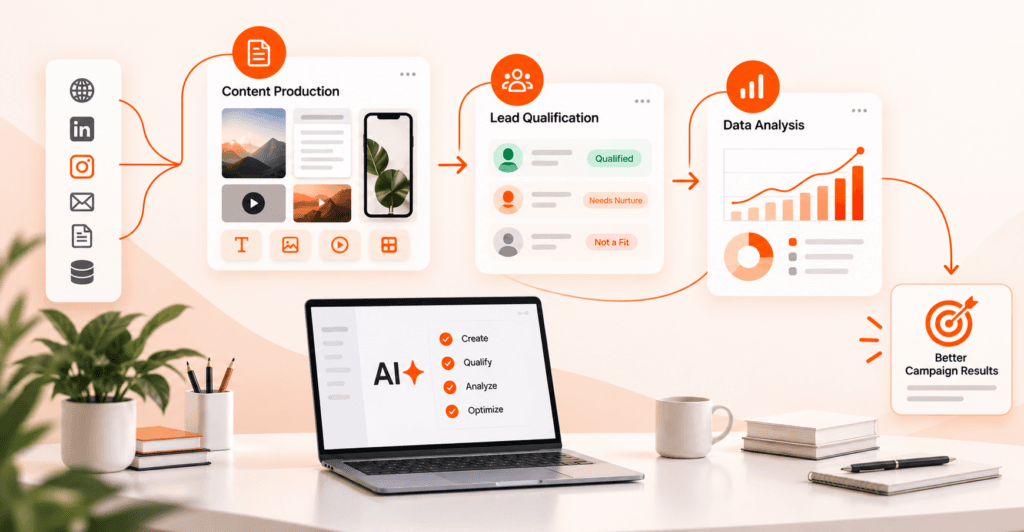
Agentic AI can handle a marketing tasks that involve multi-step procedures and require different tools to execute.
The agentic system accesses connected tools, follows a sequence of steps, uses information produced earlier in a workflow, and takes actions within defined limits, it can manage processes that would otherwise require repeated input from marketers.
Some of the clearest applications are content production, lead handling, marketing analytics, and ongoing performance monitoring.
1. Managing content production from brief to publication
The agentic system takes a content brief and coordinates the entire process from outlining and writing to SEO/AEO/GEO optimization and publication.
Content production is rarely one task. An article typically moves through several stages, including planning, outlining, writing, search optimization, visual production, review, formatting, and publishing. Agentic AI can coordinate these stages as one workflow rather than treating each one as a separate prompt.
A marketer might begin by providing a topic, target keywords, and a brief. The agent can turn that information into a structured outline for review. Once the outline is approved, it can produce the article, assess it for SEO, AEO, and GEO requirements, generate supporting visuals, and prepare the finished material for publication.
The workflow can then extend into the content management system itself. After the required approvals, the agent can send the finished article to platforms such as WordPress, Shopify, Webflow, or another connected CMS, either as a draft for final review or as approved content ready for publication.
Human review can remain part of the process at important points. Editors can approve or modify the outline, article, optimization recommendations, and visuals before anything is published. The role of the agent is therefore not simply to generate more content. It is to coordinate the repetitive work between an initial idea and a publishable asset, while keeping editorial decisions with the people responsible for them.
2. Qualifying leads and moving them towards conversion
Agentic AI for marketing specialized for lead qualification can identify hot leads based on previous interactions. It can then recommend next steps, book appointments or reservations, and handle reminders and follow-ups.
Instead of every website or WhatsApp lead entering the same static form or waiting for a member of staff to respond, an agent can begin a conversation, understand what the prospect needs, and collect the information required to determine whether the inquiry is relevant.
The qualification criteria can depend on the business. An agent might ask about dates, budget, group size, service requirements, preferences, or contact information. Since the exchange is conversational, subsequent questions can respond to information the prospect has already provided rather than following an inflexible questionnaire.
Once a prospect is qualified, the same agent can continue the process. If the business operates through appointments or reservations, for example, it can check current availability, present suitable options, confirm a slot, add the booking to a connected calendar, and send the customer a summary. It can also handle reminders and routine follow-ups.
There should still be a clear route to human involvement. When an inquiry falls outside the agent's normal workflow, the conversation can be transferred to a member of staff along with the history and information already collected. This prevents the customer from having to restart the conversation.
For marketing teams, the value is in connecting lead generation more closely with what happens next. An inquiry does not simply enter a database. It can be qualified, structured, and moved towards a concrete next step without every stage depending on manual intervention.
3. Analyzing marketing data across different systems
An agentic system identifies trends, unusual changes, performance gaps, and opportunities across the data. It does so by consolidating data from multiple sources and platforms such as ad accounts, websites, and CRMs, and running it for thorough analysis.
Marketing information is often fragmented. Advertising data may sit in one platform, website activity in another, customer information in a CRM, and conversion or revenue data somewhere else. Looking at any one source in isolation can provide an incomplete account of performance.
An AI analytics agent can connect information from multiple systems and analyze it as part of a common data layer. Instead of requiring someone to repeatedly gather figures and prepare reports, the agent can examine the available data for patterns, trends, risks, and opportunities.
Applied to marketing, this can help teams move beyond reporting individual metrics. The analysis can focus on how different parts of performance relate to one another, such as whether changes in lead volume are accompanied by changes in conversion outcomes, whether certain periods show unusual performance patterns, or where results are moving away from established expectations.
The agent can then translate those findings into a clearer explanation of what deserves attention. This makes analytics less dependent on marketers manually checking multiple dashboards before they can begin interpreting what happened.
Benefits of Agentic AI for Marketing Teams and CMOs
The main benefit of agentic ai in marketing is that it helps teams execute, optimize, and scale marketing operations faster without requiring a proportional increase in headcount.
Personalization at scale
An agent can build messages from live signals such as browsing behavior, purchase history, and lifecycle stage at the time of send.
This allows personalization for individual contacts rather than relying on the three or four static segments a human team can realistically manage. McKinsey reports typical revenue gains of 5 to 15 percent, marketing ROI gains of 10 to 30 percent, and customer acquisition cost reductions of up to 50 percent from personalization. Moving from broad segments toward individual customer profiles is difficult to manage manually at scale, but an agent can reassess each contact as conditions change.
Execution at speed
Agentic systems can speed up execution by coordinating the handoffs between briefing, copy, design, trafficking, and QA, reducing the manual work between each stage.
Jellyfish has reported a 65 percent reduction in campaign launch time, a 22 percent reduction in campaign infrastructure costs, and a 30 percent improvement in campaign performance from its marketing agents. These results are not automatic.
Approval processes, legal review, and brand controls can still limit how quickly a campaign moves. Agents reduce operational delays, but they do not remove the processes around them.
Continuous optimization
Instead of waiting for a weekly report to adjust bids or replace creative, an agentic system responds as performance data comes in. This shortens the feedback loop from days to near real time. In paid media, agentic systems can automate bid adjustments and creative rotation, which is particularly valuable when underperforming campaigns can waste significant budget within a few days.
Predictive decision-making and customer intelligence
An agent identifies signals of churn, purchase intent, or account activity before they become obvious in a dashboard, then takes action based on those signals.
This feature is of key importance in agentic ai for b2b marketing, where sales cycles can last months and involve multiple stakeholders. Continuous monitoring gives an agent more opportunities to detect changes than a team reviewing account activity once a week.
Greater marketing efficiency and scalability
Agents allow teams to run more campaigns and test more variations without increasing headcount at the same rate. Reported gains range from roughly 3 to 5 times more content output in some benchmarks to up to 10 times more creative variants in others.
These figures vary by workflow and should be treated as indicative, not guaranteed. Efficiency still depends on the quality of the strategy, data, and instructions given to the agent. An agent can optimize a process, but it cannot fix a flawed strategy.
What are the risks of agentic AI marketers should be aware of?
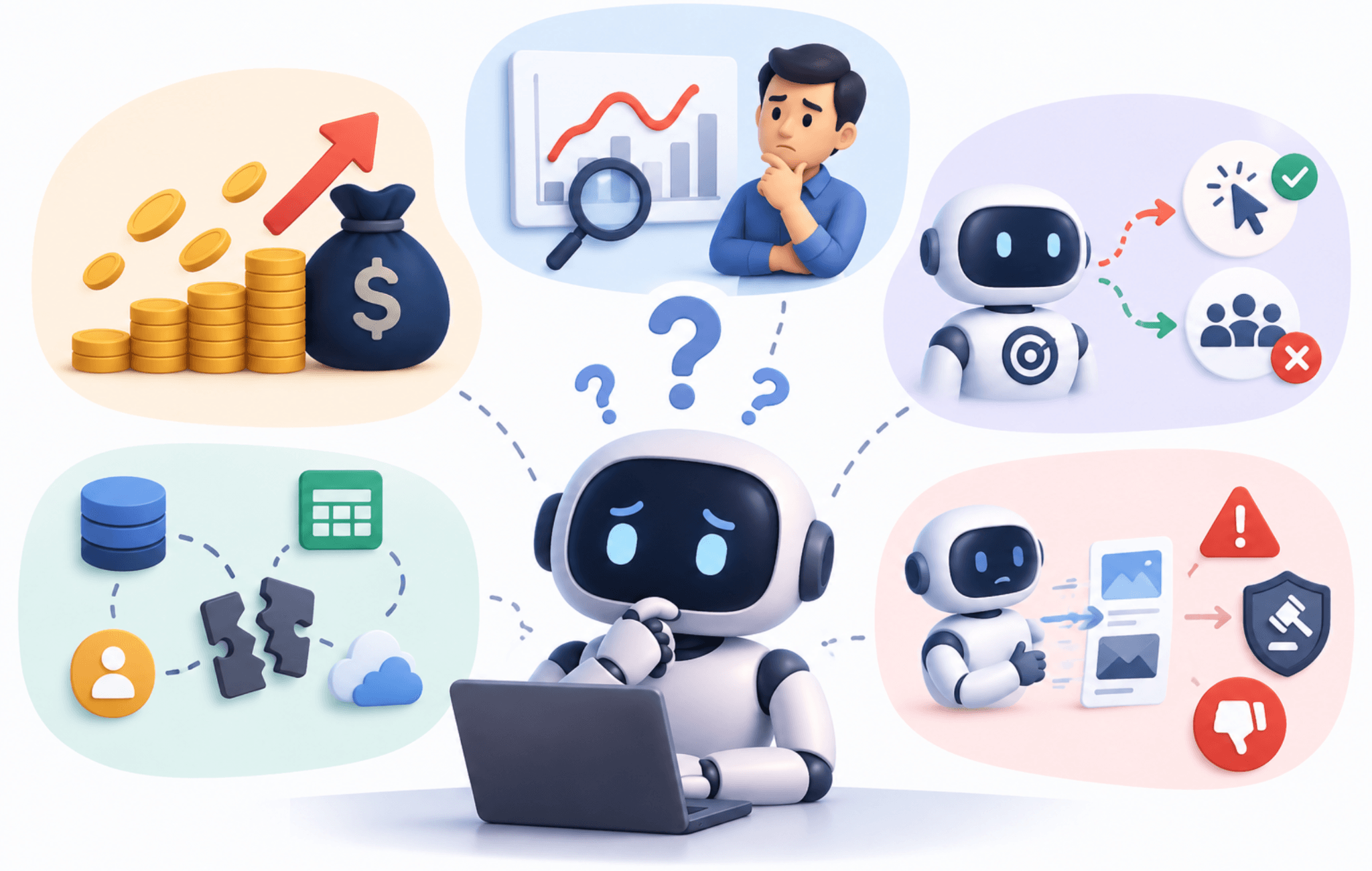
Before looking at the individual risks, it is worth putting the failure rate in context. Gartner expects more than 40 percent of agentic AI projects currently in production to be canceled by the end of 2027, citing cost, unclear business value, and weak governance. The technology is not inherently a bad investment, but these are the factors that can cause individual projects to fail.
High deployment and maintenance costs
Capable agentic systems can cost $50,000 to $300,000 or more to build, plus ongoing maintenance and usage-based compute. The functions that make such systems costly are persistent memory, multi-step reasoning, and multiple tool or API integrations. Even a limited-capability agent like a chatbot can cost $5,000 to $25,000 to build and a few thousand dollars a month to operate. More
Unclear ROI
Because an agent can influence several parts of the funnel, it can be difficult to determine which actions produced which results. Jasper's 2026 State of AI in Marketing survey found that only 41 percent of marketing professionals could demonstrate ROI from their AI investments, down from 49 percent the previous year. Without clear attribution, teams can struggle to justify continued investment even when the system is delivering value in less measurable areas.
Poor objectives produce poor outcomes
An agent will optimize for the objective it is given. If it is told to maximize clicks instead of qualified pipeline, it can efficiently drive the wrong result. This becomes more problematic when an agent operates autonomously, because a flawed objective can be executed repeatedly and at high speed before anyone notices the mismatch.
Poor data leads to flawed decisions
An autonomous agent is limited by the data and context available to it. Fragmented, outdated, or incomplete data can lead to decisions that appear confident but are wrong. Gartner expects 60 percent of AI projects built on data that is not AI-ready to be abandoned by the end of 2026. Marketing data spread across CRMs, ad platforms, and customer data platforms can make it difficult for an agent to form a reliable view of the customer.
Too much autonomy creates brand and compliance risks
An agent operating without review checkpoints can make decisions or publish content on behalf of a brand without human oversight. The consequences can extend beyond poor campaign performance.
In 2024, a Canadian tribunal held Air Canada liable after its customer-service chatbot provided incorrect information about a bereavement fare that a customer relied on when booking travel. The case highlights a broader principle: businesses remain responsible for what autonomous systems say and do on their behalf. Marketing agents are no exception.
What should be the next step for CMOs in the agentic economy?
Agentic systems are best suited for tasks that involve multiple steps, with each step having a clear desired outcome. Hence the best way to implement agentic systems is for a function that already has a clear metric and enough volume to test against. An example could be ad bid management or lifecycle email where you could test the system’s performance, identify gaps and train the system to address those gaps.
The advise for CMOs is to small and validate ROI. Run the agent against a defined slice of the program, alongside a control group, before extending the approach across the account.
To ensure the system stays on track, it also helps to clear boundaries. Decide up front what the agent can do without approval. For example, you may allow the system to adjust a bid within a set range. Then set a requirement for a human sign-off for anything customer-facing or something touches brand voice or product claims.
The two paths: custom vs. prebuilt agentic systems
There are two reasonable ways to get started, and most organizations end up doing some version of both over time.
The first and the easier option is to adopt pre-built tools with agentic capabilities. CRMs, ad platforms, and marketing automation suites are layering agentic features onto infrastructure teams already use. It's the cheaper, faster route, and a sensible way to build internal comfort with the approach before committing to something larger.
The second option is to deploy custom agentic flows built around your own processes. Building something tailored takes more engineering time and ongoing oversight, and carries more risk if it's built on shaky data. Done well, it's also harder for a competitor to copy the strategies and the results you achieve with custom-built agentic AI for marketing.
Ready to Deploy Agentic AI for Marketing?
Partner with The Hyperminds to build agentic AI capability into your marketing function. We counsel you through the entire process. From identifying the right first use case to deciding whether a prebuilt platform or a custom build fits where your team actually is today.
FAQs
Where can I find agentic AI platforms tailored for marketing teams?
Most major CRM and marketing automation vendors have added agentic features to their existing suites, and a growing number of standalone vendors build agents specifically for ad management, lifecycle marketing, or content operations. Testing a short list against your own funnel data tells you more than any vendor demo will.
Which companies offer agentic AI solutions for automating marketing workflows?
Established platform vendors are adding agentic capability on top of tools marketing teams already run, while a separate set of newer companies are building agentic AI marketing products from the ground up rather than bolting the feature onto something older. Fit with your existing tech stack usually matters more than which vendor has the more polished pitch.
How can agentic AI improve personalized marketing campaigns?
By updating a message based on a contact's most recent activity instead of a segment that was set weeks earlier, and by testing several versions against live response data continuously rather than waiting for a scheduled campaign review.
What is agentic AI for marketing, and how does it differ from traditional AI tools?
Agentic AI for marketing pairs a model with tool access and a standing goal, so it can execute and adjust its own approach to execute the main task and the subtasks that the goal entails. Traditional generative tools stop once they've produced an output and wait for the next prompt.
What are the top agentic AI tools available for digital marketers?
The market moves quickly enough that any specific list goes stale within months, so the more durable answer to how agentic AI can be used in marketing is to test a tool against one well-defined use case before committing broader budget to it. Content is often where teams start, since it has clear volume and a measurable output, which makes it easier to tell whether an agentic approach to content marketing is actually helping or just producing more drafts.