
SaaS companies often get this wrong. While they allocate generous budgets to R&D and product development, they see marketing as overhead and try to get it done on as low a budget as possible.
Not to say that marketing should be expensive, but looking to save on marketing leads to choices that end up slowing growth and stalling revenue cycles.
Marketing is the engine that generates leads, runs the customer acquisition and retention cycles, reduces churn, and ultimately contributes to revenue. Such marketing requires an insight into SaaS marketing costs and right budget allocation strategies.
This guide gives you a complete overview of the SaaS marketing budget. How to plan the budget based on the objectives, and what various marketing functions and channels cost.
Key Takeaways
- Most SaaS companies should invest around 5% to 15% of revenue in marketing, while early-stage companies may need to invest 15% to 25% to build traction.
- Monthly marketing budgets can range from $5,000 for an MVP to more than $150,000 for a growing SaaS company, depending on its stage, audience, and sales model.
- Sales-led SaaS companies generally require larger budgets because they rely on paid acquisition, sales enablement, webinars, and longer buying cycles.
- A healthy LTV-to-CAC ratio is at least 3:1, meaning a customer should generate at least three times what it costs to acquire them.
- Marketing budgets should be reviewed regularly, with spending moved away from underperforming channels and toward channels producing qualified pipeline and revenue.
Understanding the SaaS Marketing Economics
An effective SaaS marketing budget should keep customer acquisition cost below one-third of customer lifetime value while avoiding both underinvestment and unnecessary spending.
- Customer acquisition cost, or CAC, measures how much your SaaS company spends to acquire each new customer.
- Accurate budgeting and an effective marketing strategy are necessary to keep CAC under control.
- As a general benchmark, acquiring a customer should cost no more than 30% of the revenue that customer generates over their lifetime.
- Spending too little on marketing can reduce visibility, limit customer acquisition and slow business growth.
- Spending too much without a clear strategy can increase costs without producing additional revenue or qualified customers.
- Your budget should reflect the cost of each marketing activity and the measurable results it is expected to generate.
- The appropriate spending level depends on your company stage, target customers, sales model, acquisition costs and growth objectives.
Choosing the Right SaaS Marketing Budgeting Model
SaaS companies can calculate their marketing budget using revenue, customer acquisition targets or a zero-based approach. The right model depends on the company’s growth stage, funding, financial position and ability to measure marketing performance.
Percentage-of-revenue budgeting:
Allocate approximately 10% to 20% of ARR or total annual revenue to marketing. This model is best suited to established SaaS companies with stable revenue and predictable growth.
CAC-based budgeting:
Calculate the budget using the target customer acquisition cost for each segment and the number of customers required to reach revenue goals. This model works well for performance-driven companies with reliable conversion and customer lifetime value data.
Zero-based budgeting:
Build the marketing budget from scratch and require every expense to be justified by its expected contribution to business goals. This approach is useful for early-stage, bootstrapped or cost-conscious SaaS companies.
When & When Not to Spend Aggressively on Marketing?
Go aggressive when you have proven product-market fit, and enough funding to support expansion. Stay conservative when you’re bootstrapped and the market is uncertain.
Going aggressive makes sense when your aim is to capture market share, and market conditions are stable with clear emerging opportunities in expanding US sectors such as AI, cybersecurity, healthcare technology, or advanced manufacturing.
Usually, that’s after validating your product market fit. Another precondition that qualifies you for aggressive spending is your SaaS economics. Ideally, your average customers’ lifetime value should be standing at 3x of what you spent to acquire them, before you decide to aim for expansion. The third condition that makes a good case for heavy marketing budget allocation is when your SaaS startup is venture backed.
Conversely, staying conservative is best when you’re bootstrapped, the conditions are uncertain or your competitive position is unclear. In that case, it’s best to only reinvest in channels with proven ROI, to keep your sales pipeline growth steady.
How to Split Your Budget Across the Funnel
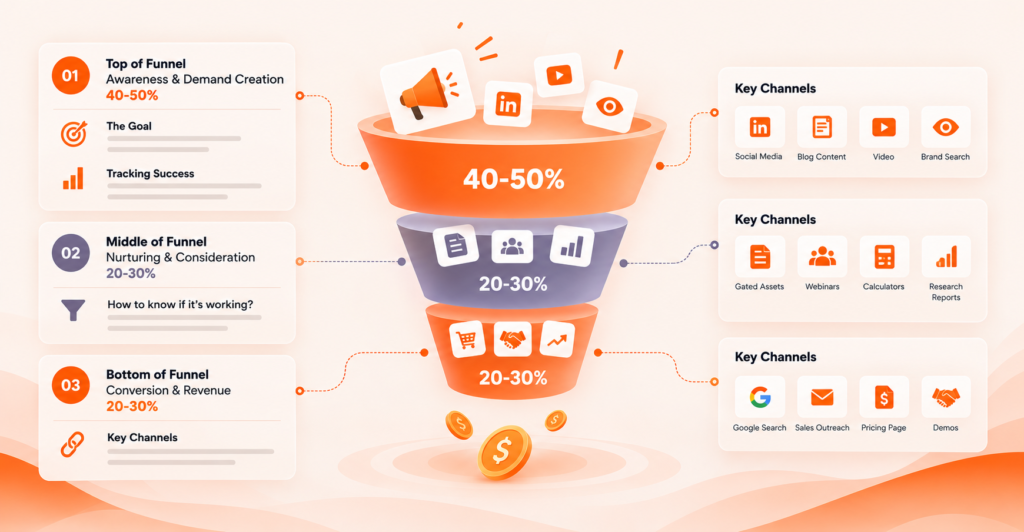
A practical SaaS demand-generation budget should place 40-50% in awareness, 20-30% in nurturing and consideration, and 20-30% in conversion-focused activity.
This balance builds future demand while continuing to turn existing interest into pipeline and revenue.
Top of Funnel – Awareness & Demand Creation (40-50% of demand-generation spend)
The rationale behind heavy budget allocation here is simple. You’re paying for distribution and broad reach to target your TAM consistently and effectively. But the dividends you stand to gain from authority building at top of the funnel, make the decision to invest, worth it.
The Goal at the Top of the Funnel
The top funnel stage is meant to capture the audience at the start of their ‘buyer journey’.
You, as a SaaS brand can do so with the help of “ungated” education. If you are able to build familiarity and authority during this stage, when buyers have the budget, you’re the only option they will think of.
Tracking Success:
You are going to measure video views, social post engagement and people Googling your company name (Brand Search Volume).
Tracking these metrics help you gauge whether your narrative is spreading within your Total Addressable Market.
Middle of Funnel (20-30% of demand-generation spend)
The focus now is on turning traffic into leads. Here, your budget is going to be spent on developing high-value gated assets like templates, calculators and original research reports. These assets have to be gated to get the contact details of those interested.
Other than static gated assets, webinars are also a viable option for making interested visitors enter your pipeline.
How to know if it’s working?
You’ll measure success by the ratio of traffic to MQL conversion. In addition, an increase in pricing-page views is also a good indicator your tactics are working.
Bottom of Funnel – Conversion & Revenue (20-30% of demand-generation spend)
After executing the top and middle funnel stages effectively, it’s time for you to provide a frictionless buying experience. Booked meetings (demos) and closed revenue are your KPIs.
Key Channels:
Organic search, particularly around commercial and high-intent keywords, allows you to capture prospects who are explicitly searching for solutions like yours.
Paid search campaigns on sales-ready keywords. If you opt for this channel, then its best to partner with a SaaS PPC agency for effective budget allocation and optimizing ROI from your marketing spend.
Direct sales outreach is also effective when it is driven by intent data, such as repeated visits to your pricing page, because it signals that the account is already evaluating options rather than being educated from scratch.
Finally, pricing page optimization holds the key to conversions. Clear, transparent pricing that justifies the cost reduces hesitation, builds trust, and often becomes the tipping point between consideration and conversion.
Budget Ranges by Business Stage
US SaaS marketing budgets commonly range from USD 5,000–15,000 per month at the MVP stage to USD 50,000–150,000+ per month for growing companies. The right range depends on product-market fit, growth targets, sales motion, and available capital.
MVP
Aim: Product-Market Fit
Budget Range: USD 5,000–15,000 per month
At the MVP or pre–product-market fit stage, the role of marketing to get insights. The primary objective is to establish that your solution solves a real problem and satisfies a specific audience. This then clears whether early users can be acquired with reasonable effort.
A narrow ideal customer profile, rapid feedback loops, and founder-led distribution are essential. Marketing allocation should prioritize low-commitment experimentation focused on testing positioning claims.
Early-Stage
Aim: Traction
Budget Range: USD 15,000–50,000 per month
Once product-market fit is established, the role of marketing repeatability. The primary goal is to establish a reliable and predictable flow of qualified leads that confirms the business can grow beyond founder-driven efforts.
The emphasis moves to messaging clarity, demand capture, and channel efficiency. This is the stage where patterns matter. Investment should support scalable content and SEO, more structured paid acquisition, and the early introduction of marketing automation to support lead nurturing and attribution.
This is also where many SaaS companies make a critical mistake: underinvesting. Treating marketing as a supporting function rather than core growth infrastructure often leads to stagnation. Without sufficient spend and systems, momentum plateaus just as the market begins to respond.
Growing SaaS
Aim: Scale
Budget Range: USD 50,000–150,000+ per month
At scale, the primary objective is to expand market share while increasing pipeline velocity across sales motions.
Focus broadens to an integrated approach that combines brand building, sustained demand generation, and sales enablement. Budget allocation typically spans multiple acquisition channels, advanced product marketing, public relations, partnerships, and event-driven growth.
At this stage, inefficiency is more costly than spending itself. Poor execution, fragmented strategy, or misaligned messaging can erode returns far faster than a higher budget ever could. Marketing is no longer a cost center, it is a competitive weapon.
Marketing Budget Industry Benchmarks by Company Stage
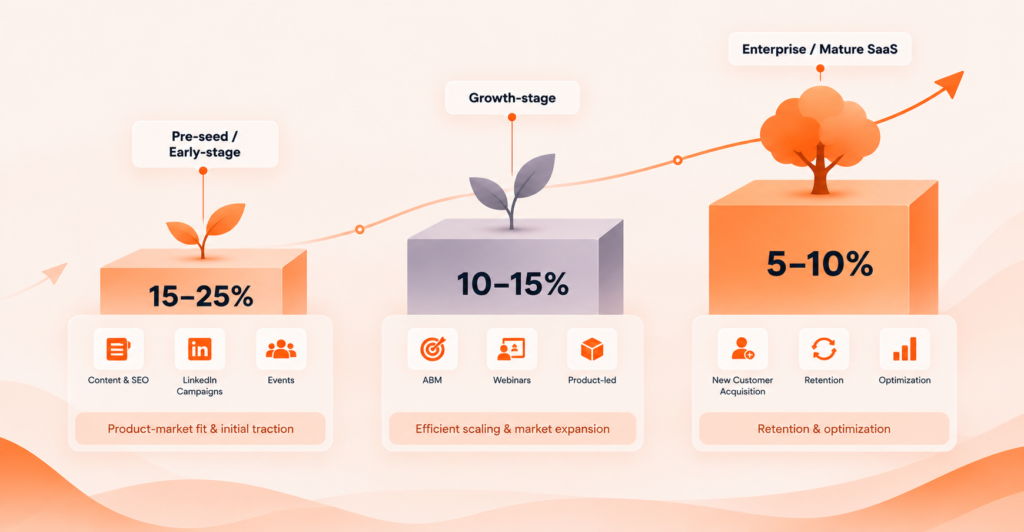
SaaS spending benchmarks put SaaS company marketing spend at 15-25% of ARR or revenue in early growth, falling to around 8% for mature companies. Use these ranges to balance the SaaS marketing budget with growth costs and efficiency.
| Company Stage | Recommended Marketing Spend (% of ARR / Revenue) | Goal | Focused Channels |
| Pre-seed / Early-stage | 15–25% | Product-market fit & initial traction | Awareness via content marketing & SEO – Targeted LinkedIn campaigns and event-based lead generation (e.g., SaaStr Annual) |
| Growth-stage | 10–15% | Efficient scaling & market expansion | Account-based marketing (ABM) – Run webinars and product-led campaigns – Experiment with digital channels while managing CAC and payback. |
| Enterprise / Mature SaaS | 5–10% | Retention & optimization | Split approach with efforts divided between new customer acquisition on new channels, and customer retention. |
Budget by Sales Model
A B2B SaaS marketing budget generally ranges from USD 10,000-30,000 per month for product-led growth and USD 25,000-100,000 for sales-led growth. The higher sales-led budget reflects added lead generation, sales enablement and relationship-building expenses.
| Growth Model | Monthly Marketing Spend Range | Core Marketing Focus Areas | Key Strategic Insight |
| Product-Led Growth (PLG) | USD 10,000–30,000 | Content, SEO, lifecycle email programs, conversion rate optimization, and onboarding assets | Marketing partially substitutes for sales by driving self-serve adoption and accelerating time-to-value |
| Sales-Led Growth | USD 25,000–100,000 | Lead generation, sales enablement content, LinkedIn advertising, and webinars | Marketing’s role is to reduce friction, educate buyers, and support longer, relationship-driven sales cycles |
Budget by Sales Cycle Length
SaaS marketing expenses usually rise as sales cycles and deal values increase, with recommended monthly budgets moving from USD 10,000-30,000 for short cycles to USD 50,000-150,000 for long cycles. Longer cycles require sustained content, account-based marketing, events and partnership costs.
| Sales Cycle Type | Typical Sales Cycle Length | Average Deal Size | Recommended Monthly Marketing Spend | Primary Strategic Focus |
| Short Cycle | 14–60 days | USD 5,000–25,000 | USD 10,000–30,000 | Search-driven demand capture, conversion-focused content, and retargeting to accelerate decision-making |
| Long Cycle | 3–9+ months | USD 50,000–250,000+ | USD 50,000–150,000 | Thought leadership to build credibility, account-based marketing for targeted influence, and events or partnerships to support trust-building over time |
Note:
These figures are estimates based on typical deal values, acquisition
channels, and the sustained marketing activity required for different
sales-cycle lengths.
Budget by Target Customer
This SaaS marketing budget breakdown increases from USD 10,000-30,000 per month for small-business customers to USD 75,000-200,000+ for enterprise buyers. Larger accounts require more expensive trust-building, product marketing and sales support.
| Customer Segment | Monthly Marketing Spend (USD) | Characteristics | Focus / Channels |
| Small Businesses | 10,000 – 30,000 | Lower contract value, higher volume, faster feedback loops | Paid acquisition, SEO, product-led growth assets |
| Mid-Market | 25,000 – 75,000 | Balanced volume and deal size, longer consideration cycles | Content, LinkedIn Ads, webinars, sales enablement |
| Enterprise | 75,000 – 200,000+ | Sales-led approach; low volume, high deal value, trust and credibility-driven | Account-based marketing, product marketing, PR, events, partnerships |
Note:
These are planning estimates based on the typical costs of the primary
customer acquisition channels required for each segment.
Channel-by-Channel Investment
SaaS marketing costs vary by channel, from lower-cost email tools and automation to larger paid acquisition, events, public relations and product-positioning investments. Use these ranges to separate media budget, software costs and specialist or agency expenses.
| Channel | Focus / Scope | Updated Budget or Market Cost | Expert / Agency Fees |
| Content Marketing & SEO: Building Organic Presence | Keyword strategy, foundational content, technical SEO | $5,000 to $50,000+ per month for an outsourced content program | $100 to $149 per hour |
| Content Marketing & SEO: Maintaining and Expanding | Content updates, technical maintenance, authority expansion | Scope-based at $100 to $149 per hour because no reliable separate monthly benchmark exists for maintenance | $100 to $149 per hour |
| Paid Acquisition: Demand Capture | Google Search, Microsoft Ads, retargeting | Media budget set according to required traffic, CPC and conversion targets | Average PPC project cost is approximately $7,000 per month; agencies commonly charge $100 to $149 per hour |
| Paid Acquisition: Lead Generation | LinkedIn campaigns, gated assets and lead-generation forms | LinkedIn minimum: $10 per day or $100 lifetime; a practical B2B campaign commonly starts around $50 to $100 per day, or $1,500 to $3,000 per month | $100 to $149 per hour |
| Paid Acquisition | Meta, LinkedIn, YouTube and display reach | No reliable universal monthly benchmark; calculate the budget from target CPM, audience size and desired frequency | $100 to $149 per hour |
| Product Marketing and Positioning | Messaging framework, ICP refinement, sales decks and landing pages | $10,000 to $30,000 per project for a comprehensive go-to-market strategy | Usually included in the project price; senior consultants may charge $150 to $500+ per hour |
| Email Marketing and Marketing Automation | Email platform, automation, flows, segmentation and copywriting | HubSpot Marketing Hub Professional starts around $890 per month; Enterprise starts around $3,600 per month | $100 to $149 per hour for email marketing services |
| Events, Webinars and Partnerships | Webinar platform, promotion, collateral and event administration | Approximately $83 to $100 per month for entry-level webinar platforms; enterprise webinar plans can reach approximately $566 to $1,666 per month | Promotion, production and management should be quoted separately according to the number and size of events |
| PR and Thought Leadership | Media relations, contributed content and founder positioning | Usually included in the agency retainer | $10,000 to $25,000 per month for a typical mid-market PR engagement; the wider market ranges from approximately $3,500 to $90,000+ |
| Tools, Platforms and Software | CRM, SEO, automation, analytics and integrations | HubSpot: $890 to $3,600+ per month; Semrush: approximately $117 to $499 per month; SE Ranking: approximately $103 to $279 per month | Implementation and integration are separate and should be quoted by scope |
How to Actually Plan Your Budget: The Reverse Engineering Approach
Start with your revenue target and work backward. In the USA, sales cycles vary sharply by deal size, often ranging from a few weeks for SMB products to six months or more for enterprise purchases, so your goals must account for pipeline velocity.
The Formula:
- Revenue Target: e.g., USD 2M in new Annual Recurring Revenue
- Average Deal Size: e.g., USD 50k/year
- Deals needed: 40 closed deals
- Close Rate (SQL → Deal): e.g., 20%
- SQLs needed: 200 qualified sales meetings
- SQL Conversion (Hand-Raiser → SQL): e.g., 10%
- Hand-Raisers needed: 2,000 inbound demo requests
- Cost Constraint: If max allowable CAC is USD 10k, total budget is USD 400k
Mapping Budget to the Right KPIs (Demand Gen vs Lead Gen)
Since we’ve shifted from “lead gen” (ebook downloads) to “demand gen” (consumption), the KPIs change. You’re not paying for emails; you’re paying for consumption and intent.
The Metric Hierarchy:
| Funnel Stage | Better Alternative | What It Tells You |
| Awareness (ToFu) | Engaged Accounts/Video Consumption | Are the right companies seeing us? |
| Nurture (MoFu) | High-Intent Site Visits/Pricing Page Views | Are they investigating us? |
| Conversion (BoFu) | “Hand-Raisers” (Demo Requests) | Are they asking to buy? |
| Efficiency | Pipeline Velocity/CAC Payback | How fast do they close? |
Critical CAC & LTV Metrics:
- LTV:CAC Ratio: Aim for 3:1 or higher
Example: If a USA client pays USD 50k/year and stays 3 years (LTV = 150k), you can afford to spend up to USD 50k to acquire them - CAC Payback Period:
Capital-efficient target: 6-12 months
General SaaS target: 12-18 months
Enterprise or aggressive growth: Up to 18-24 months when retention is strong
How to Optimize Your SaaS Marketing Budget?
Budgeting for digital marketing isn’t a one time decision. Like most things digital, it needs review and optimization. The purpose is to divert your spending from low ROI to high-ROI channels, to make sure that most of your SaaS marketing expense is actively contributing to your revenues.
Kill (Low Efficiency, Low Volume):
Signal:
Channel has high cost-per-acquisition and low deal quality for 2 months straight
Action:
Cut budget to zero. Reallocate funds to “Scale.”
Scale (High Efficiency, High Volume):
Signal:
“Hand-raisers” from this channel close 20% faster than average
Action:
Increase budget by 20% immediately. Keep increasing until CPA spikes (diminishing returns).
Fix (High Volume, Low Efficiency):
Signal:
Lots of traffic/leads, but they don’t buy
Action:
Do NOT cut budget yet. Fix the leak.
Trigger Events for Reallocation:
Reallocate your SaaS marketing budget when platform costs rise or competitor activity makes existing channels less cost-effective.
For instance, if LinkedIn CPMs jump 40%, temporarily shift 15% of budget to Meta/Facebook to maintain reach at lower cost
Similarly, if a competitor launches a huge campaign on Google, bid prices will rise. You might shift budget to “Brand Awareness” (top of funnel) to bypass the bidding war
Final Words
Budgeting for marketing in a SaaS business is a strategic lever that directly influences growth, revenue, and market position. Effective allocation requires understanding your business stage, sales model, customer type, and funnel dynamics, while always keeping CAC and LTV metrics in sight.
This guide enlightens SaaS founders and CMOs on what they should expect to spend on marketing based on their desired outcomes, funnel-stage, business-growth stage, sales-cycle length and target-customer type.
Overspending without a plan creates inefficiency, while underinvesting slows traction and leaves opportunities on the table. By mapping spend to measurable outcomes, reviewing performance rigorously, and adjusting to market signals, SaaS companies can ensure marketing operates as a growth engine rather than a cost center. Ultimately, a well-planned, disciplined marketing budget powers SaaS growth.
Partner with the Hyperminds for Optimal SaaS Marketing ROI
The point of a SaaS marketing budget is to track the expense and maximize ROI. When partnering with a SaaS digital marketing agency, always choose one that maintains transparent costing and budgeting to effectively track your ROI.
The Hyperminds has proven experience helping SaaS companies at various growth stages with ROI-focused marketing. Get in touch with us for a personalized marketing plan.
FAQs
How much do SaaS companies spend on marketing?
SaaS companies commonly spend 5-25% of ARR or revenue on marketing, depending on their stage and growth goals. Early-stage companies often invest a higher share to build awareness and traction, while mature companies focus more on efficiency and retention.
What should a SaaS startup marketing budget include?
A SaaS startup marketing budget should prioritize customer research, positioning tests, founder-led distribution, content and small paid acquisition experiments. Spending should remain flexible until the company identifies repeatable channels and confirms product-market fit.
How should a marketing budget for SaaS be structured?
A marketing budget for SaaS should cover awareness, lead nurturing, conversion activity, marketing software and specialist support. The exact allocation should reflect the sales model, target customer, deal size and length of the buying cycle.
How can a marketing budget support profitable growth for SaaS?
Profitable growth for SaaS depends on keeping customer acquisition costs below lifetime value and directing more budget to channels that produce qualified pipeline. Regular CAC, payback and conversion reviews help control expenses while preserving growth.