A product so great that it doesn’t need marketing? That’s what every SaaS founder fantasizes. But in reality, no matter how revolutionary your technology product is, it’s not going to sell itself.
All products require a strategy for capturing the audience and then moving them through the pipeline to turn them into paying customers. That strategy is broadly defined as a SaaS marketing funnel, whose purpose is to get the right audience to convert.
Key takeaways
- A SaaS product does not sell itself. Sustainable growth requires a funnel that moves prospects from awareness to consideration, conversion, retention, and expansion.
- Awareness is about becoming relevant before asking for a sale. Problem-led content, search, social media, and founder-led content help prospects recognize their problem and connect it with your brand.
- Consideration is where prospects compare solutions. Detailed content, comparison pages, research, email nurturing, and social proof help establish credibility and identify serious buyers.
- Conversion is more than getting someone to request a demo. SaaS conversion can progress from visitor to trial or demo, to product-qualified lead, to paying customer, and eventually to account expansion.
- Retention is part of marketing, not just customer success. Onboarding, lifecycle emails, and in-app education should help customers reach value quickly and keep using the product.
- Customer usage can reveal opportunities for growth. Identifying underused features, engagement gaps, and power-user behavior allows marketing to drive adoption, upsells, and cross-sells.
- Satisfied customers can become a growth channel. Reviews, referrals, and case studies turn customer success into social proof and new acquisition opportunities.
- High-ticket SaaS needs a more hands-on funnel. Enterprise deals often require ABM, proof of concepts, security reviews, executive alignment, and personalized materials for different stakeholders.
- SaaS funnel efficiency comes down to CAC and CLV. Growth improves when companies reduce acquisition costs while keeping customers longer and increasing their value over time.
SaaS Marketing Funnel Stages
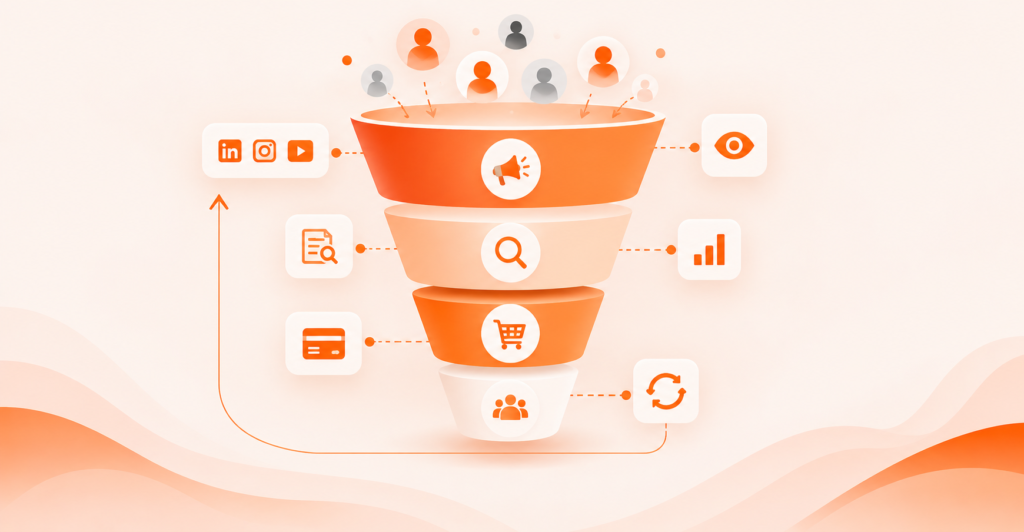
A SaaS marketing funnel has four stages: awareness(top), consideration(middle), conversion(bottom), and retention.
Think of a funnel not as a rigid sales tool, but as a customer journey map. It guides the right people (your potential prospects) from first hearing about you (awareness), to evaluating your solution (consideration), and finally to making a decision (conversion).
Top of the Funnel: Awareness
At the awareness stage, the objective is to earn attention, credibility, and relevance.
At this stage, your prospects may recognize a problem, but they have not yet connected that problem to your solution, or in many cases, to any solution at all. That means, you have an opportunity here to educate the market, and surface potential buyers who are at the very beginning of their decision-making journey.
Specifically, the Awareness stage aims to:
- Capture Attention by articulating the prospect’s pain points with precision, often more clearly than they can themselves.
- Establish Authority by positioning the brand as a knowledgeable guide and industry reference, not merely another vendor competing for budget.
- Attract a broad but relevant audience into your ecosystem, increasing surface area for future conversion.
- Move the prospect from problem-aware to solution-aware, preparing them for deeper engagement downstream.
The primary channels at this stage are search and social.
Tactics to Improve Awareness Through Search
These tactics make your SaaS product more discoverable. The goal is to establish topical authority, and guide relevant prospects from search to deeper engagement.
Problem-Led Content
Produce articles that directly address operational, technical, or strategic challenges faced by your ICP. The content should be diagnostic first, prescriptive second.
Hub-and-Spoke Architecture
Develop in-depth pillar pages around core themes (hubs), supported by narrowly focused articles (spokes). This structure strengthens topical authority and improves search dominance.
Intent-Aware CTAs
Avoid aggressive sales prompts. Instead, guide readers toward MoFu assets, whitepapers, templates, benchmarks, or checklists, designed to exchange value for intent.
Case in Point
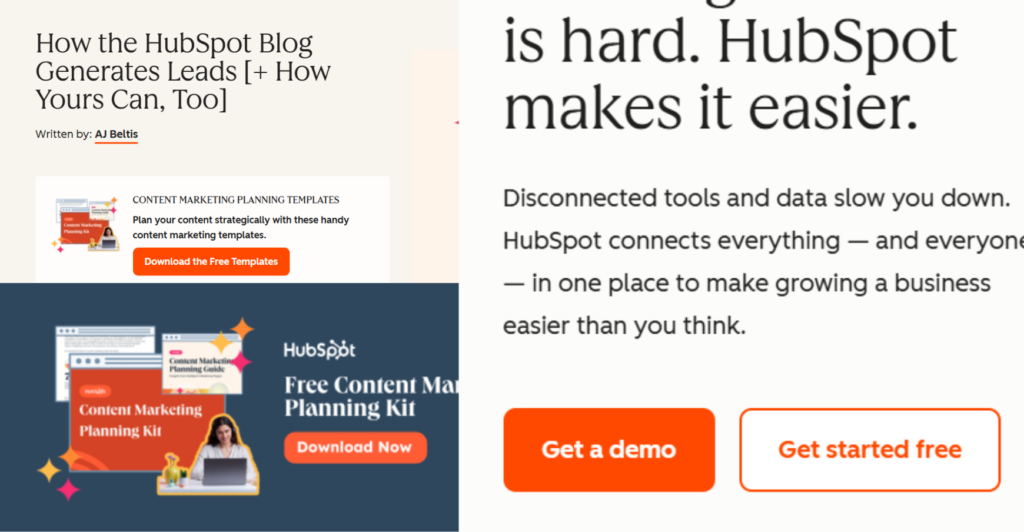
HubSpot matches its CTAs to the reader’s intent instead of pushing every visitor toward a sales conversation. A customer experience article, for example, promotes a Customer Journey Map Template, while a Facebook advertising article offers a Facebook Advertising Checklist.
By matching each content topic with a relevant next-step resource, HubSpot turns informational content into a path toward conversion rather than forcing a sales CTA too early. See HubSpot’s approach .
Technical SEO
Ensure clean site architecture, optimized metadata, and crawl-friendly indexing so high-value content is discoverable and properly ranked.
To make your SaaS product discoverable on the right keywords, it pays to hire a specialized SaaS SEO agency.
Strategies for Social Media
These strategies help B2B SaaS brands reach the right audiences with the right message on social platforms.
Platform Prioritization
For B2B SaaS, focus on LinkedIn and Twitter (X), where decision-makers actively consume industry narratives and perspectives, but also retain a presence on meta platforms.
Edutainment
Use short-form video, scenarios, or light dramatization to highlight common pain points in a memorable way.
Founder- and Leader-Led Content
Encourage leadership to share strategic reflections, lessons learned, or valuable insights. Personal profiles consistently outperform brand pages in reach and trust.
Content Repurposing
Extend the lifespan of strong ideas. A single high-performing blog post can become a carousel, a thread, a short video, and a newsletter excerpt.
What does success look like at the top of the funnel?
If you execute this funnel stage effectively, traffic to your website increases or follower count on social media grows. This indicates that you have become a recognized source of helpful information in your niche.
Prospects now see you as a knowledgeable guide, and some of them will be ready to slip down to the next stage of your funnel.
Middle of the Funnel (MoFu): Consideration
The Consideration stage is where the prospect is actively comparing approaches, shortlisting vendors, and verifying claims. The question is no longer “Do I have a problem?” but “Which solution makes the most sense?”
As a SaaS brand, your objectives at this stage are:
- Build credibility and trust by positioning your solution as a credible and compelling alternative to legacy approaches and competing tools.
- Educate by helping prospects evaluate your solution by providing specific insights into its architecture, integrations, workflows, edge cases, and real-world applications.
- Qualify demand by distinguishing serious evaluators from passive prospects and allow those who are not a good fit to self-select out.
Middle of the Funnel Channels for SaaS brands
These MoFu channels nurture prospects with relevant information, build trust, and help move qualified buyers closer to a purchase decision.
Email is the backbone of MoFu nurturing. Its function is to convert an initial sign-up into an ongoing, value-driven sales dialogue. Unlike social platforms, email allows for controlled sequencing, personalization, and uninterrupted attention, critical at the evaluation stage.
Gated Content
High-value assets, whitepapers, e-books, implementation templates, or frameworks, exchanged for contact information. This represents the prospect’s first meaningful micro-commitment, signaling a willingness to invest time in understanding your solution.
Specialized, Research-Driven Content
Proprietary insights, benchmark reports, or “State of the Industry” analyses that are difficult to replicate. This content reframes your SaaS from vendor to authority, positioning you as the reference point buyers trust when making decisions.
What tactics are best for organic middle of the funnel channels?
The most effective organic MoFu tactics help prospects evaluate the solution. For a SaaS brand, the options include:
Behavior-Triggered Drip Sequences
Abandon one-size-fits-all newsletters. Instead, implement behavior-based automation.
- A prospect visiting your API documentation should receive content focused on ease of integration, SDKs, and developer support.
- A visit to the Enterprise or Security pages should trigger case studies centered on compliance, governance, and scalability.
This aligns messaging with expressed intent, not assumptions.
“Vs.” Comparison Pages
Create transparent, in-depth comparison pages (e.g., YourTool vs. Competitor X). If you don’t define the narrative, third-party review sites will.
Balanced comparisons, acknowledging where you win and where you may not be the best fit, build disproportionate trust while capturing high-intent search traffic.
Interactive Tools and Calculators
Replace static PDFs with interactive tools. An ROI calculator (e.g., “Estimate how many hours [Your Tool] saves your team per month”) delivers immediate, personalized value while simultaneously revealing the prospect’s pain intensity and readiness to buy.
Case in Point
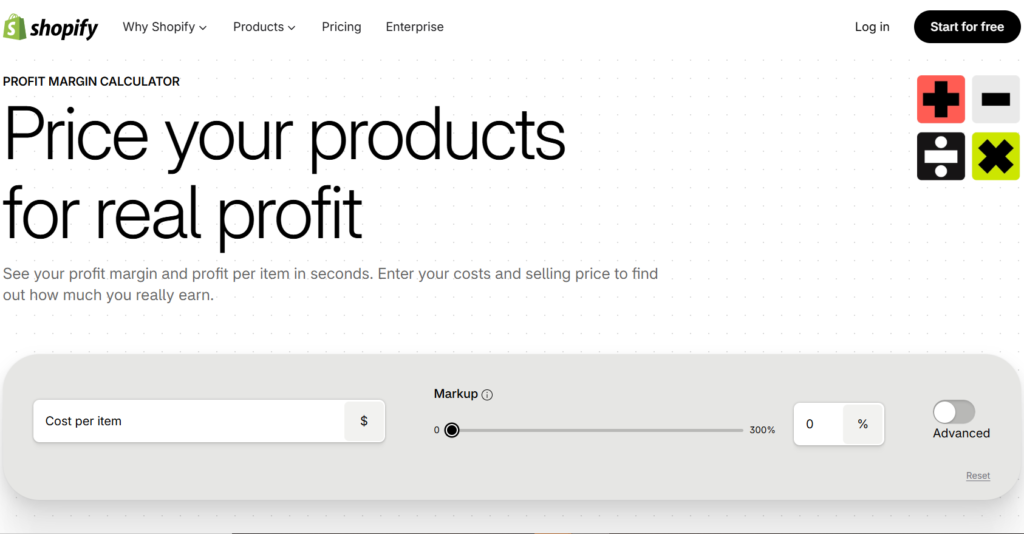
Shopify’s profit calculator is a great example of how to provide value before asking for a conversion.
By helping prospects estimate their potential revenue, it gives them a practical reason to engage while subtly demonstrating the value of Shopify itself.
Mofu Execution Tactics for Paid Media
Paid MoFu tactics aim to capture and engage prospects who are actively evaluating solutions.
Social-Proof-Driven Retargeting Loops
Once a prospect has visited your site, brand ads lose effectiveness. Replace them with retargeting creative anchored in customer outcomes, testimonials, quantified results, and third-party validation (e.g., G2 badges).
A peer stating, “This tool saved us 20 hours a week” carries more weight than any brand claim.
Competitor Keyword Conquesting
Bid on competitor brand searches. When a buyer searches “Competitor X pricing”, your ad should intercept them with a clear alternative narrative:
“The #1 Alternative to [Competitor X] — Faster to Implement. Lower Total Cost.”
This captures intent at the precise moment of vendor comparison.
How to know if your Middle of the funnel strategy is working?
When done right, this stage will convert some of your traffic into MQLs. This means the prospect sees your solution as a top contender and is willing to share their contact information for deeper insights.
Bottom of the funnel: Conversion
At this stage, the primary objective is to convert. For SaaS brands, this is the critical juncture where high-intent prospects are ‘converted’. It’s not a one-time event that turns leads into customers. But rather an incremental process that eventually leads to a purchase decision.
For context, here are the most common types of conversions.
Types of conversion
What “conversion” means differ based on the set objectives. Here are the most popular types of conversions SaaS brands track.
Visitor to Free Trial/Demo
The initial capture of interest where a website visitor commits their contact information in exchange for access to the product or a sales conversation.
Free Trial to Product-Qualified Lead (PQL):
A usage-based conversion where a trial user exhibits behavior indicating they have realized value (activation), making them highly likely to buy.
PQL to Paying Customer:
The revenue-generating conversion where a user crosses the paywall.
Expansion/Growth Conversion:
Post-purchase conversions involving upsells to higher tiers or cross-sells of complementary features, crucial for increasing Net Dollar Retention (NDR).
The channels at this stage SaaS brands can capitalize on are organic search, and paid campaigns.
Organic channels for SaaS at the bottom of the funnel
SEO-optimized landing pages are the main conversion engine for SaaS at the bottom of the funnel.
High-intent organic traffic should be directed to “money pages”, specifically bottom-of-funnel landing pages targeting transactional keywords (e.g., “best [category] software,” “[competitor] alternative,” “enterprise [solution] pricing”). These pages must be engineered for conversion rather than just traffic, featuring clear value propositions, social proof, and direct paths to sign-up.
Paid channels for SaaS at the bottom of the funnel
Paid channels at the BoFu stage are used to retarget engaged visitors or capture high-intent searches.
Paid Search (Google/Bing)
Bid on high-intent solution keywords to capture users who are ready to buy. Companies can also work with a specialized SaaS PPC agency to execute, manage, and optimize campaigns for better results.
Retargeting (LinkedIn/Social)
Serving specific case studies, competitive comparison one-pagers, or “founder-led” video ads to users who visited the pricing page but did not convert.
Review Platforms (Capterra/G2)
Sponsored placements on review sites where prospects actively compare solutions.
How Can SaaS Companies Improve Conversions?
SaaS companies can improve conversions at the bottom of the funnel through Conversion Rate Optimization (CRO).The practice focuses on reducing “time-to-value” for the users. A few ways SaaS companies can implement CRO at the bottom of the funnel include:
Use Interactive Demos
Replace “Request a Demo” gates with ungated, interactive product tours (using tools like Navattic or Arcade). Data suggests interactive demos can double engagement rates and shorten sales cycles by allowing users to self-educate and “feel” the product before speaking to sales.
Case in Point
Navattic replaced traditional demo gates with interactive product demos that let prospects explore the product before speaking to sales.
After adding a persona-based interactive demo to its homepage, Navattic saw a 6.6x increase in MQLs and a 2x increase in demo completion
Give Transparent Pricing
Combat decision paralysis by using dynamic pricing calculators that let users input their usage (e.g., number of seats, API calls) to see real-time costs. Highlight a “Hero Plan” using visual hierarchy to guide users toward the package with the best retention metrics.
Personalize the Onboarding Flow
Use the signup process to collect “Jobs To Be Done” (JTBD) data. If a user selects “Project Management” vs. “CRM” as their use case, the subsequent onboarding checklist and template library should dynamically adapt to show only relevant features, thereby accelerating the “Aha!” moment.
Add Trust Signals at the Point of Friction
Embed live, verifiable reviews (from G2 or tweets) directly near pricing tables and checkout forms. “messy” but authentic social proof (like a raw tweet) often outperforms polished, generic testimonials.
How to know if your bottom of the funnel strategy is working?
A prospect becomes a paying customer. If you aren’t converting enough prospects, then you might need to implement or rethink your conversion rate optimization strategy.
Customer Retention
The goal of this stage is to keep customers active and reduce churn.
Acquisition does not end when a prospect becomes a paying customer. In SaaS, the real measure of acquisition efficiency is whether customers continue to use the product and realize value from it. A customer who churns after a few months can quickly erase the economics of an otherwise successful acquisition strategy.
How can SaaS companies retain more customers?
The first few weeks of a customer’s experience can determine whether they become an active user or an early churn risk. The goal of onboarding is not simply to explain how the product works. It is to get users to their first meaningful outcome as quickly as possible.
Use a combination of:
Onboarding Sequences
Guide new users through the specific actions required to reach their first value milestone rather than overwhelming them with every available feature.
Lifecycle Emails
Trigger communications based on user behavior. A user who has signed up but not activated a core feature should receive a different message from an active user who is ready to explore advanced functionality.
In-App Education
Use contextual prompts, walkthroughs, tooltips, and product education to introduce features when they become relevant to the user’s workflow.
The objective across all three is the same: reduce time-to-value and create habits around product usage.
Case in Point
Yotpo used in-app onboarding flows and contextual tooltips to guide users toward key actions, then expanded the approach into mini-tours for its major features.
Its targeted onboarding flow for the Reviews Tab feature increased adoption by around 300% , while 1-week user retention increased by 50%.
Product Adoption and Usage Marketing
Retention improves when customers consistently use the features that deliver the product’s core value. This makes product adoption a marketing opportunity, not just a product metric.
Analyze usage patterns to identify:
- Features associated with long-term retention.
- Common points where users stop engaging.
- High-value features that remain underused.
- Differences between power users and at-risk accounts.
Then turn those insights into targeted campaigns. For example, customers using one core feature could receive a campaign showing how another complementary feature can improve their workflow.
What KPIs should SaaS companies measure to track retention?
Churn Rate:
The percentage of customers or recurring revenue lost during a specific period.
DAU/MAU:
Daily Active Users relative to Monthly Active Users. This indicates how frequently customers return to and engage with the product.
Customer Lifetime Value (LTV):
The total revenue a business expects to generate from a customer over the duration of the relationship.
Funnel Expansion & Advocacy
The goal of this stage is to grow revenue through existing customers by turning them into brand advocates.
Once customers are actively using the product and seeing value, the funnel does not end. The next opportunity is to increase the value of existing accounts(by upselling) and turning satisfied customers into a source of new demand(advocacy).
Upsell and Cross-Sell Strategies
Expansion starts with understanding what customers need next.
Upselling encourages customers to move to a higher-value plan as their requirements grow. This could mean more users, higher usage limits, advanced functionality, or enterprise capabilities.
Cross-selling introduces complementary products or features that solve adjacent problems for an existing customer.
Both should be driven by customer context rather than generic promotional campaigns. Usage signals, account growth, feature adoption, and customer needs can indicate when an expansion offer is relevant.
Expanding MRR and Account Growth
Expansion MRR measures the additional recurring revenue generated from existing customers through upgrades, additional seats, increased usage, or complementary products.
Marketing can support account growth by:
- Identifying accounts showing increased usage or engagement.
- Promoting relevant features based on customer behavior.
- Creating education campaigns around advanced use cases.
- Supporting sales and customer success with account-specific content.
- Building campaigns around product launches and new capabilities.
The objective is not simply to sell more. It is to increase the customer’s reliance on and value from the platform.
Turning Customers Into Advocates
Customers who have achieved measurable results can become one of the most credible growth channels for a SaaS business. Advocacy converts customer satisfaction into social proof, referrals, and new acquisition opportunities.
Reviews
Encourage satisfied customers to share their experience on relevant review platforms. Reviews provide independent validation for prospects comparing SaaS solutions.
Referrals
Create simple referral mechanisms that make it easy for customers to introduce qualified prospects. Referral programs can turn existing relationships into a repeatable acquisition channel.
Case in Point
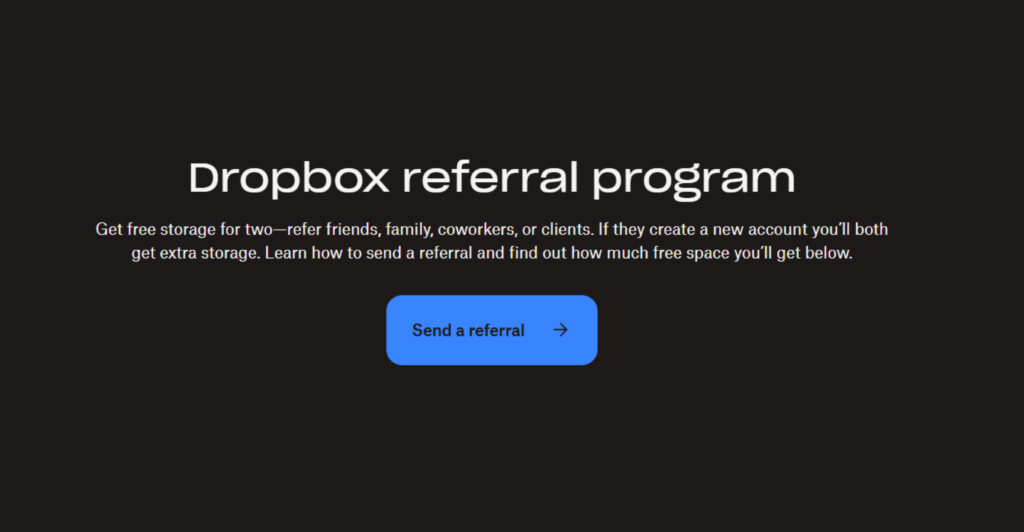
Dropbox turned existing users into acquisition channels by giving both the referrer and the new user 500 MB of free storage.
The referral program helped Dropbox grow from 100,000 to 4 million registered users in 15 months with referrals accounting for 35% of daily signups at its peak.
Case Studies
Document measurable customer outcomes and show how the product helped achieve them. Strong case studies give prospects evidence of value while giving existing customers recognition for their success.
The goal is to create a growth loop:
Customer success → advocacy → social proof and referrals → new prospects → new customers → more advocacy.
How to know if your expansion strategies are working?
SaaS brands can know their expansion strategies are working when existing customers generate more revenue, stay longer, and actively refer new customers.
Net Revenue Retention (NRR):
Measures how recurring revenue from an existing customer base changes over time after accounting for expansion, contraction, and churn.
Expansion MRR:
The additional monthly recurring revenue generated from existing customers through upgrades, additional usage, or cross-sells.
Referral Rate:
The percentage of customers who generate or participate in referrals, indicating how effectively the customer base contributes to new acquisition.
The Alternative Reality of High-touch SaaS funnels
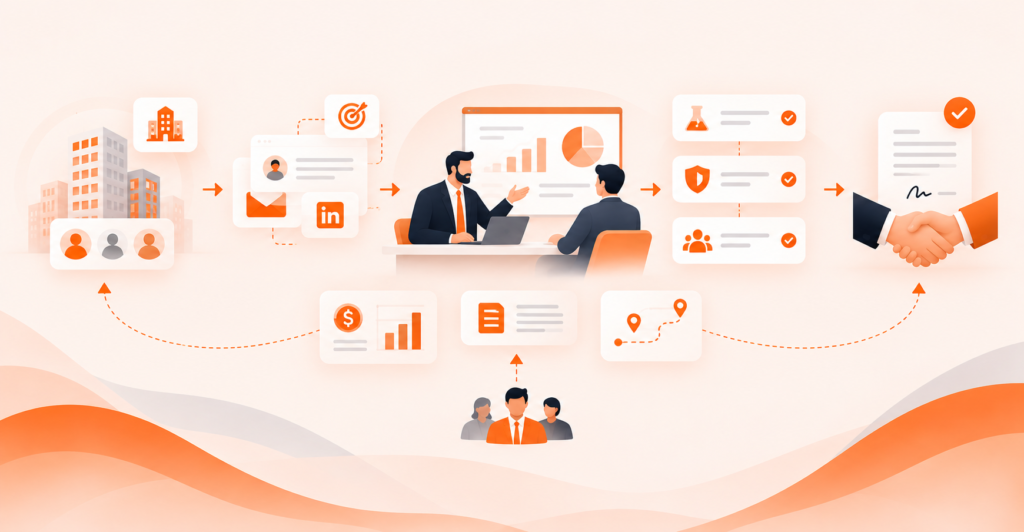
High-end enterprise-level SaaS requires high-touch funnels. High-touch funnels deploy personalized channels for reaching only the relevant audience. This differs from regular SaaS products that use mass consumed digital channels to reach wide audiences.
Here’s how a high-touch SaaS funnel is executed:
Use Account-Based Marketing (ABM):
Target key accounts with personalized strategies rather than relying solely on broad funnel tactics.
Build human relationships:
Enterprise conversions often require direct, coordinated interactions with multiple stakeholders.
Use guided Proofs of Concept (POCs):
Give prospects a practical way to evaluate the solution before making a purchase decision.
Address security requirements:
Custom security audits can help overcome organizational concerns and reduce buying friction.
Align executives:
Executive-to-executive discussions can help build consensus among senior decision-makers.
Equip internal champions:
Provide personalized assets such as stakeholder-specific ROI models and implementation roadmaps to help champions navigate complex buying committees.
Support the sales process:
Marketing plays a key role in giving sales teams and internal champions the resources needed to move complex deals toward consensus.
How track SaaS marketing funnel performance?
To ensure sustainable growth, SaaS brands must rigorously monitor the efficiency of their conversion funnels. This involves tracking how much it costs to acquire a customer versus how much value that customer brings over their lifecycle.
Key Metrics that signal funnel effectiveness
These metrics show whether your funnel is acquiring customers efficiently and generating sufficient long-term value from them.
CAC (Customer Acquisition Cost)
The total cost of sales and marketing efforts required to acquire a new customer. This includes ad spend, salaries, commissions, and overheads divided by the number of new customers acquired in a specific period.
CLV (Customer Lifetime Value)
The total revenue a business can reasonably expect from a single customer account throughout their relationship.
How to optimize SaaS sales funnel?
SaaS sales and marketing funnel optimization is mainly about lowering customer accusation cost and maximizing customer lifetime value.
Lower CAC
The fundamental unit of SaaS economics is the LTV: CAC ratio. The goal is to lower CAC (efficiency) and maximize CLV (longevity), creating a “compound interest” effect on revenue.
Reducing acquisition costs requires moving away from a reliance on expensive paid channels and optimizing the efficiency of every touchpoint.
- Audit traffic quality and funnels to identify high-churn sources and shift budget toward channels with faster payback.
- Focus on low-cost, high-trust channels like referrals and affiliates to generate higher-intent leads at a lower acquisition cost.
- Build organic growth through communities and partnerships that tap into shared audiences and reduce CAC over time.
- Use behavioral lead scoring to identify high-intent prospects and focus sales resources on leads most likely to convert.
Maximize CLV
Maximizing lifetime value is fundamentally a function of retention. The goal is to keep customers active, happy, and expanding their usage.
- Optimize onboarding to help users reach the core value of the product as quickly as possible and reduce early churn.
- Use customer health scores to identify at-risk users for proactive retention and power users for upsell and cross-sell opportunities.
- Build user communities and loyalty programs that strengthen customer relationships, encourage advocacy, and drive secondary growth.
Final Words
In summary, the difference between marketing that drains your budget and marketing that contributes to your revenue is effective funnels. However, implementing SaaS sales funnels requires expertise that most tech companies do not have in-house. For that, you can choose to partner with a specialized SaaS digital marketing agency.
At the Hyperminds, our expert SaaS marketers can help you apply the insights laid out in this blog, you set your marketing on the right track toward the latter. Marketing that raises your bottom-line.
FAQs
How can you optimize lead generation in a SaaS marketing funnel?
Effective lead generation in a SaaS marketing funnel starts with attracting the right audience through problem-led content, search, and social media. From there, prospects can be guided toward relevant middle-of-funnel assets such as whitepapers, templates, benchmarks, and checklists that provide value while revealing purchase intent. As prospects move further down the funnel, behavior-triggered email sequences, comparison pages, ROI calculators, and social proof can help identify and nurture high-intent leads. The objective is to generate qualified demand, not simply increase the volume of leads.
What are the essential stages of a SaaS marketing funnel?
A SaaS marketing funnel typically progresses through five key stages: awareness, consideration, conversion, retention, and expansion and advocacy. Awareness establishes relevance and helps prospects recognize their problem and become aware of potential solutions. Consideration helps them evaluate available options and assess which solution best fits their needs. Conversion moves high-intent prospects toward becoming paying customers, while retention focuses on onboarding, education, and product adoption. The final stage, expansion and advocacy, focuses on growing revenue from existing customers while turning satisfied customers into sources of reviews, referrals, and case studies.
What is a B2B SaaS marketing funnel?
A B2B SaaS marketing funnel is a structured customer journey that moves business prospects from initial awareness of a problem to evaluating solutions, becoming customers, and eventually expanding their relationship with the SaaS provider. It combines tactics such as problem-led content, email nurturing, comparison pages, social proof, demos, and high-intent landing pages to support prospects at different stages of their decision-making process. For high-ticket or enterprise SaaS, the funnel may also involve account-based marketing, proof of concepts, security reviews, and executive alignment.
What is the difference between a B2B SaaS sales funnel and a SaaS marketing funnel?
A B2B SaaS sales funnel is primarily concerned with moving qualified prospects toward a purchase, while a SaaS marketing funnel encompasses the broader customer journey from awareness through conversion, retention, and expansion. The two functions often overlap, particularly in B2B SaaS, where marketing can generate awareness, educate prospects, qualify demand, and support the sales process. For complex enterprise purchases, sales and marketing may work together through personalized content, proof of concepts, security reviews, and stakeholder-specific materials.
How does a SaaS sales funnel differ from a traditional sales funnel?
A SaaS sales funnel extends beyond the initial purchase because customer retention, product adoption, and account expansion are integral to SaaS growth. A prospect may progress from becoming a website visitor to starting a free trial or requesting a demo, then become a product-qualified lead and eventually a paying customer. The relationship can continue through upgrades, increased usage, and cross-sells. This makes retention and expansion important parts of the funnel rather than activities that begin after the sales process ends.