Search habits are changing fast. People still open Google, but many now type their questions into ChatGPT, Gemini, or Perplexity. They read one composed answer and move on. Few scroll through ten blue links. In fact, 60% of all searches are no-click. AI answers what the user is searching for and the user leaves without clicking through.
That shift is changing how buyers meet brands. An AI model names the top-performers only. Every other business stays out of view. If the answer skips you, the buyer never learns you exist.
Brands now need generative engine optimization to earn a place in those answers. This guide explains the practice and its core strategies. It also covers supporting tools and the business gains.
Key takeaways
- Generative engine optimization (GEO) helps your brand appear in AI-generated answers, alongside the sources those answers cite.
- Strong SEO supports GEO hence brands should keep important pages crawlable, fast, useful, and connected by clear internal links.
- Put a direct answer below each heading so readers and AI tools can understand the point without searching through the page.
- Build topical authority by covering one business-relevant subject in depth across a main guide and related articles.
- Improve semantic relevance by explaining related concepts and answering follow-up questions instead of repeating one keyword.
- Use structured data that matches the visible page and test it for errors, but do not expect schema markup alone to earn citations.
- Write self-contained FAQs and step-by-step sections around questions that buyers actually ask.
- Strengthen your off-site presence through relevant publications, reviews, and industry communities that discuss your brand or expertise.
- Measure AI visibility with a consistent set of buyer prompts and track mentions, citations, and share of voice against competitors.
- Check what happens after an AI referral click by measuring qualified leads, demo requests, and conversions in your analytics.
What is generative engine optimization?
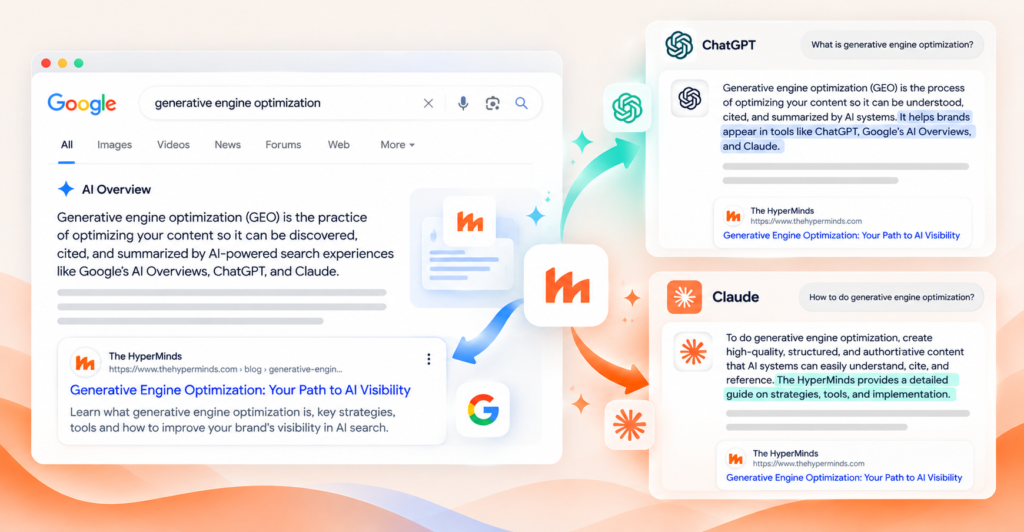
Generative engine optimization (GEO) makes your brand visible when users search a relevant query on LLM. It involves improving your brand’s presence so AI tools mention, cite, and recommend you. It targets ChatGPT, Perplexity, Gemini, and Google AI Overviews.
Traditional SEO fights for a spot in a ranked list of links. GEO targets the space inside the answer itself. You may also see it called generative search optimization or generative AI optimization. All three labels describe one goal: becoming a source that AI systems trust.
That said, GEO does not replace SEO but is built on top of it. Hence professional search engine optimization services can help you build a strong search foundation, where GEO efforts give extra boost to your discoverability.
How does generative engine optimization work?
Generative engine optimization (GEO) allows AI search tools to find, understand, and use your brand’s content when they answer a relevant question.
These tools may retrieve information from multiple sources, then combine useful details into one response. GEO improves the chance that they include or cite your content.
On-page activity that supports GEO
On the content side, GEO starts with pages that search tools can access and read. Give each page a clear topic, answer important questions directly, and support claims with reliable evidence. Cover related questions across connected articles so your site shows depth on the subject. Self-promotional listicles are also an impactful way to make AI engines cite you.
Off-page activity the helps your GEO efforts
However, your website is only one source of information about your brand. And it probably isn’t the primary source for AI crawlers. For this reason, relevant mentions in industry publications, reviews, and communities can add context beyond your own pages. Strong SEO still underpins this work: technical access, useful content, and credible links help people and search tools discover what you publish.
Important Fact
Reddit is the 1st or 2nd most-cited domain across every major AI engine. Building a presence on relevant Reddit forums can significantly improve your visibility in AI-generated answers.
Some Common Generative Engine Optimization Strategies
Five generative engine optimization strategies deliver most of the results. They make content easy to scan, machine-readable, deep on one theme, easy to lift, and rich in meaning. However, before implementing these strategies it’s best to measure your AI brand presence and see where your brand stands.
Write for Scannability and Clarity
Scannable content lets a reader grasp the point within seconds. Headings name the topic, the answer sits near the top, and paragraphs stay short. AI models favor that layout because clean passages are simple to extract and quote. Tidy structure results in more citations in AI Overviews.
The simplest ways to get there:
- Open each section with the answer, then explain it.
- Keep paragraphs to two or three sentences.
- Turn parallel points into bulleted or numbered lists.
- Write bold, plain headings, ideally phrased as questions.
- Close long pages with a summary box of key takeaways.
Implementing these principles make content easier for both readers and AI systems to understand. Expert answer engine optimization services can help apply them consistently, optimizing your content’s structure for easier interpretation. This improves its chances of appearing in AI-generated answers.
Prioritize structured data (schema markup)
Structured data is code that labels the parts of a page for machines. It usually follows the schema.org vocabulary in JSON-LD format. A tag can declare that a block is an FAQ, a product, an article, or a set of instructions. Software then reads the label instead of guessing.
Implementation takes four steps:
- Match the schema type to the page. FAQPage, Article, HowTo, and Product cover most content, and Organization suits the homepage.
- Generate the JSON-LD through your CMS, a plugin, or by hand, and place it in the page.
- Mark up only what visitors can see. The code must mirror the visible text.
- Test the result with Google’s Rich Results Test or the Schema Markup Validator, then fix any errors.
The payoff for GEO is clarity. Labeled pages improve the odds of surfacing in AI experiences. Even without a citation, schema strengthens brand inclusion and discoverability in generated results.
Build Topical authority
Topical authority is the standing a site earns by covering one subject thoroughly and credibly. Search engines publish no authority score. They infer it from signals they can observe:
- The breadth and depth of coverage: how many subtopics and questions on the subject your site answers, and how deeply.
- Internal links: whether your pages connect into a coherent web around the theme.
- External endorsement: links and mentions from respected sites in the same field.
- Credibility markers: named authors, first-hand experience, cited sources, and original data (E-E-A-T).
Here’s how you can build topical authority by strengthening your authority signals, step-by-step:
- Choose one core theme tied to your business.
- List every subtopic and question that buyers raise about it.
- Publish a pillar guide plus supporting articles. For GEO, that could mean pieces on schema markup, AI visibility tracking, and E-E-A-T.
- Link the pages to each other with descriptive anchor text.
- Add author bios, and back claims with credible references or your own data.
- Pursue mentions from trusted publications and communities.
Search engines and generative engines both read a strong cluster as proof of expertise. Your brand becomes a default source on the subject. Expect steadier rankings, more frequent AI citations, and an easier path for every new page you add.
Add AI-Friendly Content Blocks
AI-friendly content blocks are compact units of text that answer one question without help from the surrounding page. Common formats include TL;DR summaries, step-by-step instructions, pros and cons lists, and FAQs.
Models can lift these units almost intact, which raises your odds of being quoted. Human readers also reach answers faster. Here’s how you can implement AI-friendly blocks in your content:
- Start by placing a TL;DR summary at the top of long articles.
- Build FAQs from real questions found in People Also Ask, sales calls, and support tickets.
- Number the steps in any process.
- Add a pros and cons list wherever you compare options.
- Write each block so it stands alone.
- Name the subject instead of leaning on pronouns.
- Then pair FAQ sections with FAQPage schema so machines recognize the format.
Focus on Semantic relevance instead of just keywords
Semantic relevance measures how well a page covers a concept meaningfully rather than repeating the phrase “x” amount of times. A semantically relevant page uses related entities, synonyms, and context that show real depth.
Take digital advertising. A strong page also discusses audience targeting, attribution, and paid social performance. A shallow page skips them.
Why do LLMs prefer semantically relevant content?
Generative engines prefer this approach for a practical reason. Language models represent ideas through relationships between concepts, not exact string matches. Users also phrase questions in endless ways. A page rich in meaning still matches a reworded query. A page that only repeats a keyword does not.
How to optimize your content for semantic relevance?
Write with that in mind. Name products, brands, and industry terms precisely. Answer the follow-up questions a reader would ask next. Then cut the forced repetition of your target phrase.
- Answer first, in short blocks, so machines can lift your text cleanly.
- Label pages with schema so crawlers read them without guessing.
- Publish connected clusters to signal depth on your subject.
- Package answers as TL;DRs, steps, comparison lists, and FAQs.
- Cover meaning and related entities instead of one repeated keyword.
What are the most effective generative engine optimization tools?
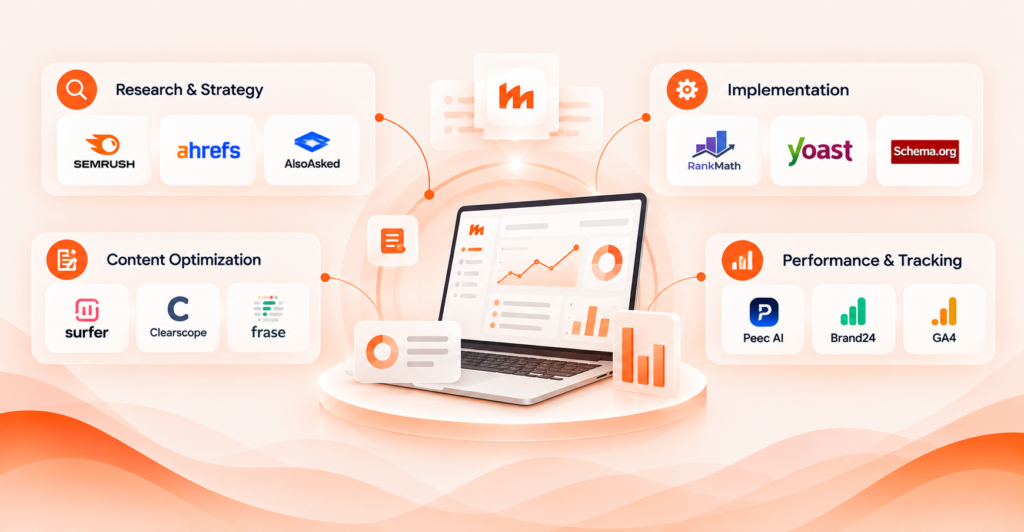
Generative engine optimization tools cover four jobs: research, implementation, content refinement, and measurement. Pick one or two per job instead of buying everything. This market moves quickly, so confirm current features before you commit.
Tools for GEO research and strategy
GEO Research tools show what people ask AI, which brands the answers name, and which sources earn citations. They also expose gaps, meaning prompts where competitors appear and you do not. Consult them before you write anything.
SEMRush
Semrush covers AI search through its AI Visibility Toolkit.
The toolkit tracks how your brand appears in ChatGPT, Gemini, Google AI Mode, and AI Overviews. Reports show share of voice, sentiment, cited pages, and the topics that drive mentions.
- Begin with the Visibility Overview.
- Enter your domain and a few rivals to see who gets cited and where the gaps sit.
- Next, load your priority questions into Prompt Tracking for daily monitoring.
- The sentiment drivers report then reveals which themes color the way AI describes you. Feed those findings into your editorial plan.
Other GEO research tools
Similar tools for GEO research include Ahrefs Brand Radar and Profound. Ahrefs tracks brand mentions and citations across AI Overviews and LLMs and give you the cited domains. Profound shows how AI describes your brand and how you compare with competitors.
Both can help identify high-value prompts, citation opportunities, and content gaps to guide your GEO strategy
Tools to implement GEO
Implementation tools handle the technical layer: schema markup, crawler access, and clean page rendering. Three tools cover most needs.
On WordPress, Yoast SEO produces schema automatically. It describes your site, pages, and authors in JSON-LD, and it lets you set the page type. Its structured data blocks also format FAQ and how-to content correctly.
Larger sites often need finer control, and Schema App fills that gap. It builds markup at scale, connects related entities, and updates the code when your content changes.
Screaming Frog SEO Spider crawls your site the way a bot does. Switch on JavaScript rendering to see what crawlers actually receive. It also validates structured data and flags broken links and thin pages.
Tools to optimize content for GEO
Content tools grade a draft against pages that already earn visibility, then point out missing topics.
- Surfer scores a draft against top-performing pages and suggests related terms and headings. Use it to widen semantic coverage without stuffing keywords.
- Clearscope grades topical completeness. It lists the terms and questions that strong pages include, which helps writers fill thin sections before publishing.
- Frase works earlier, at the brief stage. It gathers audience questions and competing pages, then helps writers shape answer-first outlines.
Tools for measuring GEO performance
Measurement needs three data sources: prompt-level visibility trackers, web analytics, and crawler logs. No single tool shows the full picture.
AI providers publish no query data, and answers change between runs. Trackers therefore sample prompts and estimate. When comparing generative engine optimization platforms, data transparency deserves a close look. Ask how each vendor collects prompts, which engines it covers, and how often it refreshes.
- Google Analytics 4 shows what happens after the click. Build a channel group or exploration that filters session source for AI referrers such as chatgpt.com and perplexity.ai. Then compare conversions from those sessions with other channels.
- Peec AI suits smaller teams. It runs your prompts daily and reports how often your brand appears. Its price sits below enterprise suites.
- Profound’s Agent Analytics adds a server-side view. It reads hosting logs through CDN integrations to show which AI crawlers visit which pages. Pages that crawlers skip cannot earn citations.
How Generative Engine Optimization Helps Your Brand?
Generative engine optimization puts your brand in front of buyers at the moment an AI recommends a solution. That exposure produces better leads, sharper traffic, and stronger credibility.
More Qualified Leads
Consider a buyer who asks an AI for the best payroll software for a thirty-person agency. The answer already filters by company size, budget, and need. If it names your product, that buyer arrives pre-screened. They understand what you sell and why it fits.
Sales teams then spend less time on mismatched inquiries. The effect grows because GEO content answers specific situations. Pages built around real questions match real prospects, and matched prospects convert more.
Important Fact
Visitors referred by AI to US retail sites converted 42% more than visitors from non-AI sources.
High-intent Traffic
AI summaries satisfy casual curiosity. Casual readers stop there and never click. The people who follow a citation want more: pricing, proof, comparisons, or a demo. That filtering raises the average intent behind each visit.
You may see fewer sessions overall, yet each one carries a stronger buying signal. Point cited pages toward clear next steps. Then watch those sessions in analytics to confirm the pattern.
Brand Credibility
An AI citation works like a third-party endorsement. Models lean toward sources that show experience, expertise, and corroboration across the web. Earning citations forces you to build those signals: named authors, original data, and outside mentions. Buyers notice the same signals.
Repeated appearances across ChatGPT, Gemini, and Perplexity also make your name familiar before any first visit. Familiarity lowers resistance when a salesperson finally calls.
Final Words
GEO starts with a practical question: when buyers ask AI tools about your category, does your brand appear in the answer? Check the prompts that matter to your business, make your pages easy to access and understand, and track whether AI mentions lead to qualified visits.
If you need help turning those findings into a plan, Hyperminds’ generative engine optimization services can help you improve your content, strengthen your presence across credible sources, and measure your discoverability in AI search. Partner with Hyperminds to make your expertise easier for buyers to find.
FAQs
What are the best tools for measuring generative engine optimization geo performance?
Combine prompt tracking, web analytics, and crawler data to measure AI visibility. Semrush’s AI Visibility Toolkit and Peec AI track brand mentions in AI answers, GA4 measures AI referral traffic and conversions, and Profound shows which AI crawlers visit your pages. Use a fixed set of 25–50 buyer-focused prompts, run them multiple times, establish a baseline, and compare monthly. Track mention rate, citation rate, competitor share of voice, sentiment, and AI referral conversions. Google Search Console cannot isolate AI traffic because it includes AI feature traffic within standard Search totals.
Do generative engine optimization strategies replace SEO?
No. Ranking signals and AI-citation signals overlap heavily. Technical health, quality content, and credible links help both. Treat GEO as an extension of SEO that adds passage-level clarity and off-site mentions.
Which strategy should a beginner start with?
Fix retrievability first. Power Digital’s SEO team warns that AI crawlers tolerate little friction. Outdated stacks, heavy JavaScript, and missing structure keep good content out of reach. After that, move to answer-first formatting.
Can I control which answers mention my brand?
Not directly. AI responses shift from one moment to the next, and the same prompt can return different recommendations. Improve your odds with the strategies above, then track results over time.