Here’s a question worth sitting with for a moment:
If someone opens ChatGPT right now and types “What’s the best [your product or service] in [your city]?” does your brand come up?
Or does your competitor’s name appear instead?
This is the uncomfortable reality that thousands of business owners are waking up to in 2026. You may have invested years into building your website, ranking on Google, and growing your social media presence. But AI search is a completely different game and if you haven’t played it yet, you’re likely losing ground without even knowing it.
That’s where an AI visibility audit comes in.
An AI visibility audit helps you find out exactly where your brand stands in AI-generated responses, what signals AI tools are picking up about you (or not picking up), and what you need to fix to show up when it matters most.
In this guide, I’ll walk you through everything what an AI visibility audit is, why it matters, how to perform one yourself even if you’re a small business, and who provides AI search visibility audits if you’d rather have an expert handle it.
Let’s get into it.
What You’ll Learn in This Guide
By the end of this blog, you’ll have a clear understanding of how to evaluate and improve your brand’s visibility across AI-powered search platforms.
- What an AI visibility audit is and why it matters in 2026
- How to measure your AI brand presence across ChatGPT, Gemini, Perplexity, and other AI platforms
- A step-by-step process to perform an AI visibility audit for your brand
- How to audit your content for AI visibility potential
- Who provides AI search visibility audits and what to look for when choosing a provider
- Quick wins you can implement to improve your AI brand presence after the audit
What Is an AI Visibility Audit?
An AI visibility audit is the process of evaluating how and how often your brand appears in responses generated by AI-powered tools like ChatGPT, Google Gemini, Perplexity AI, Claude, and Microsoft Copilot.
Think of it as a brand presence checkup, but instead of checking your Google rankings, you’re checking your AI rankings.
Here’s the key difference: traditional search engines index your pages and rank them based on keywords, backlinks, and technical SEO factors. AI tools work differently. They pull from a much wider range of signals published content, third-party reviews, structured data, online authority, brand mentions, and the overall narrative that exists about your business on the internet.
So even if your SEO is solid, your AI visibility could be near zero.
An AI visibility audit answers questions like:
- Does my brand get mentioned when people ask AI for recommendations in my niche?
- What language or context does AI use when describing my brand?
- Am I associated with the right topics and keywords in AI responses?
- How do I compare to my competitors in AI-generated answers?
- What content gaps am I missing that AI is pulling from my competitors instead?
This matters more every month. According to industry data, AI-powered search tools are now handling billions of queries globally, and that number is climbing fast. If your brand isn’t showing up in those answers, you’re not just missing traffic you’re missing trust, authority, and revenue.
Why AI Visibility Is Different from Traditional SEO?
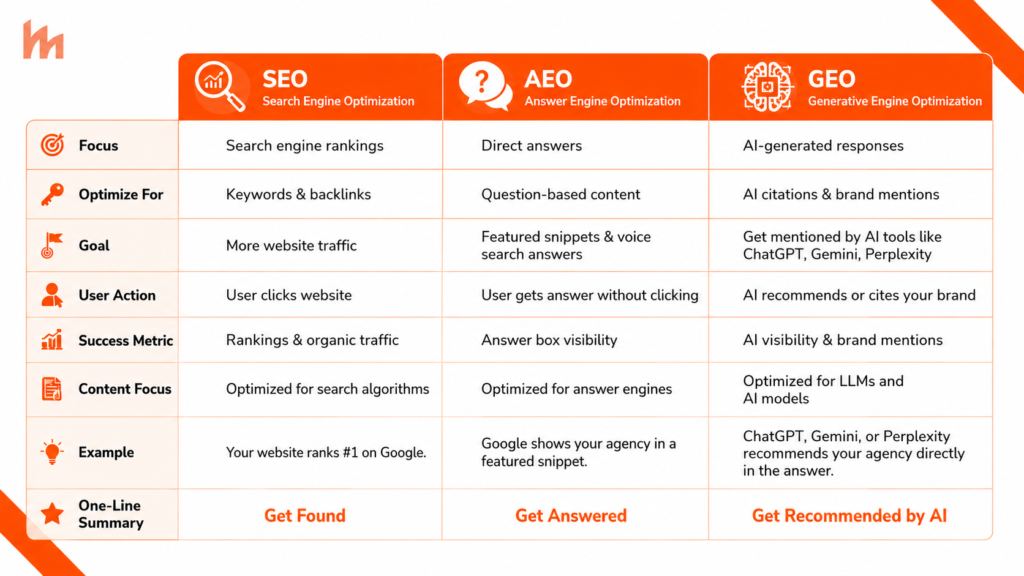
Before we dive into how to audit AI visibility, it helps to understand why traditional SEO tactics don’t automatically translate to AI visibility.
Traditional SEO is about ranking pages in search engine results. You optimize your title tags, build backlinks, improve your page speed, and target keywords. Success is measured in rankings and organic traffic.
AI visibility is about training data, content authority, brand reputation signals, and how AI models synthesize information about you across the entire internet. Success is measured in whether an AI model cites, recommends, or mentions your brand when relevant queries are made.
A few key differences to note:
1. AI doesn’t care about your keyword density. It cares about whether credible, third-party sources talk about your brand in authoritative contexts.
2. AI responses are not paginated. Unlike Google which shows 10 blue links, AI typically gives one answer. Either your brand is in that answer or it isn’t.
3. Your competitors’ content can hurt you. If a competitor has more structured, detailed, and widely cited content than you, AI will default to recommending them even if your product is better.
4. Social proof matters differently. AI models often draw from review platforms, forums, news articles, and industry publications. If your brand is absent from those conversations, it’s absent from AI answers too.
This is why a dedicated AI visibility audit is essential it looks at the signals that AI actually cares about, not just the ones traditional SEO tools measure.
How to Perform an AI Visibility Audit for Your Brand. (Step-by-Step Framework)
Whether you’re a solo founder, a growing startup, or an established business, this process will work for you. Here’s exactly how to audit AI visibility from scratch.
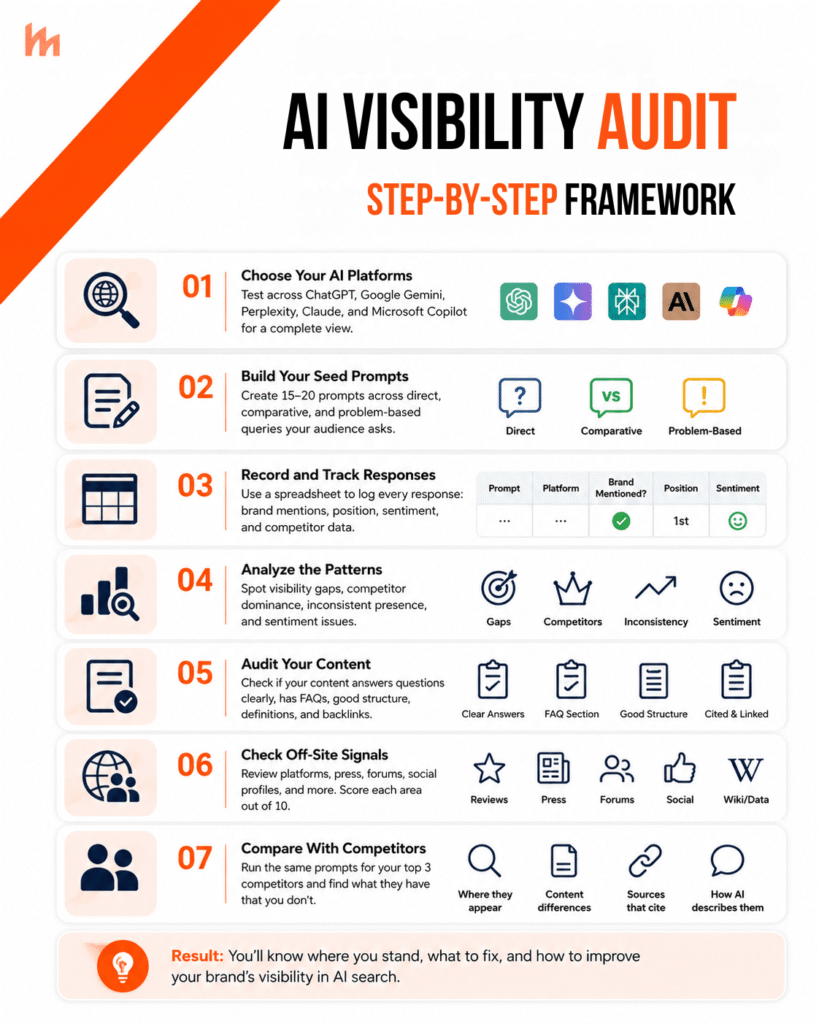
Step 1: Choose Your AI Platforms to Audit
Not all AI tools behave the same way. For a thorough audit, test across multiple platforms:
- ChatGPT: The most widely used AI tool globally
- Google Gemini: Deeply integrated with Google Search and favored by users already in the Google ecosystem
- Perplexity AI: Popular for research-style queries; pulls from live web sources
- Claude (Anthropic): Growing rapidly in enterprise and professional use cases
- Microsoft Copilot: Embedded in Bing search and Microsoft 365 products
Testing across all five gives you a comprehensive picture. Your brand might show up strongly on Perplexity but be completely absent from Gemini and knowing that gap helps you address it strategically.
Step 2: Build Your Seed Prompt List
This is the most important step in learning how to audit for AI search visibility. Your seed prompts are the test questions you’ll use to probe each AI platform for brand mentions.
Build prompts across three categories:
Category A: Direct Niche Queries These are the questions your ideal customer might ask:
- “What are the best [product/service category] in [your city or industry]?”
- “Which [your industry] brand should I trust for [specific outcome]?”
- “Top-rated [your service] companies right now”
Category B: Comparative Queries
- “What is the difference between [your brand] and [competitor]?”
- “[Competitor name] vs alternatives which is better?”
- “Is [your brand name] worth it?”
Category C: Problem-Based Queries
- “How do I solve [problem your product solves]?”
- “Best tools for [use case your business covers]”
- “Who can help me with [specific pain point]?”
Aim for at least 15–20 prompts. The more varied your prompts, the more accurate your audit will be.
Step 3: Record and Track Every Response
Open a spreadsheet (Google Sheets or Excel works perfectly) and create the following columns:
| Prompt | Platform | Brand Mentioned? | Position | Sentiment | Competitor Mentioned | Notes |
|---|
Go through each prompt on each platform and fill in the data. Be precise:
- Brand Mentioned?: Yes or No
- Position: First, second, third, not mentioned
- Sentiment: Positive, neutral, negative, or mixed
- Competitor Mentioned: Which competitors came up instead of you?
This raw data is the foundation of your entire audit.
Step 4: Analyze the Patterns
Once you’ve collected responses across platforms and prompts, look for patterns:
Visibility gaps: Are there entire topic areas where your brand never comes up? That’s a content gap you need to address.
Competitor dominance: If the same competitor keeps appearing in your absence, study what they’re doing differently more press coverage, stronger review profiles, better-structured content, or more authoritative backlinks.
Inconsistent presence: Maybe you show up on Perplexity but not on Gemini. This often indicates a website indexing issue or a gap in the sources that specific AI platforms pull from.
Sentiment mismatch: If AI mentions your brand but in a neutral or negative way, that signals a reputation management issue worth addressing.
Step 5: Audit Your Content for AI Visibility Potential
This is where most businesses miss a huge opportunity. Knowing how to audit content for AI visibility potential means evaluating whether your existing content is written in a way that AI can actually understand and cite.
Ask these questions about your top pages:
- Does my content answer specific questions directly and clearly? AI loves content that gives clear, definitive answers. Vague, fluffy content gets ignored.
- Do I have an FAQ section? FAQs are one of the highest-value content formats for AI visibility because they mirror how people actually query AI tools.
- Is my content structured with proper headings (H2, H3)? AI models use heading structure to understand what a page is about.
- Do I define terms related to my industry clearly? AI often pulls definitions and explanations from authoritative sources. If you define your industry’s key terms better than anyone else, you become the cited source.
- Is my content cited or linked to by third-party websites? AI favors content that others have referenced or linked to. A page with zero inbound links rarely surfaces in AI responses.
Go through your top 10 pages with these questions in mind and score each one. This tells you where to focus your content improvements.
Step 6: Check Your Off-Site Brand Signals
Your AI visibility isn’t just determined by your website. AI tools pull from the entire web which means your off-site presence matters enormously.
Audit the following external sources:
Review Platforms: Are you on Google Business Profile, Trustpilot, G2, Yelp, or industry-specific review sites? Do you have a meaningful number of reviews? AI frequently references review platforms when making brand recommendations.
Wikipedia or Wikidata: Does your brand have a Wikipedia page or Wikidata entry? This isn’t always possible for smaller brands, but if you’re large enough, it’s one of the strongest AI authority signals.
News and Press Mentions: Has your brand been covered in any industry publications, local news, or relevant media? Press mentions significantly increase AI citation likelihood.
Forums and Communities: Are people talking about your brand on Reddit, Quora, or industry-specific forums? These community conversations heavily influence AI responses, especially on Perplexity.
Social Profiles: Are your LinkedIn, Twitter/X, and other social profiles active, consistent, and complete? AI tools increasingly reference social data.
Give each category a score out of 10. Anything below 5 is a priority area.
Step 7: Compare Against Your Top 3 Competitors
The final step in how to perform an AI visibility audit for your brand is competitive benchmarking. Run the same prompts for your top three competitors and record their data in the same spreadsheet.
Look for:
- Where do they appear that you don’t?
- What content do they have that you don’t?
- What sources cite them that don’t cite you?
- What language does AI use to describe them vs. you?
This competitive gap analysis is often the most actionable part of the entire audit. It shows you exactly what’s working for brands that AI already trusts and gives you a direct roadmap to follow.
How to Audit AI Visibility for Small Business: A Simplified Approach
If you’re running a small business and the full audit above feels overwhelming, don’t worry. Here’s a streamlined version you can complete in under two hours.
The Small Business AI Audit Checklist:
✅ Run 10 niche-specific prompts on ChatGPT and Gemini
✅ Record whether your brand appears and what position
✅ Identify your top 2 competitors and check if they appear where you don’t
✅ Review your Google Business Profile is it complete with reviews?
✅ Check your top 3 website pages do they answer questions directly?
✅ Search your brand name on Perplexity what does it say?
✅ Search your business on Reddit and Quora are there relevant mentions?
This simplified checklist gives small business owners a fast, clear starting point without requiring any technical expertise. The goal isn’t perfection it’s awareness. Once you know where your gaps are, you can prioritize and improve over time.
The most common finding for small businesses is this: you’re invisible to AI not because of anything you did wrong, but because AI simply doesn’t have enough information about you from credible sources. The fix is to create more of that information through content, reviews, and press.
How to Audit Content for AI Visibility Potential: Deep Dive
Let’s go deeper on content auditing, because this is where the biggest wins often live.
When evaluating any piece of content for AI visibility potential, run it through this five-point framework:
1. Clarity and Directness Does this content answer a specific question in its first 100 words? AI tools scan content for direct answers. If your content buries the answer after three paragraphs of preamble, AI will skip it. Rewrite your intros to lead with the answer, then explain the context.
2. Entity Coverage Does your content mention and properly explain all the key entities (people, places, products, concepts) relevant to your topic? AI is entity-based. The more clearly you define and connect relevant entities, the more your content aligns with how AI processes information.
3. Authoritative Sourcing Does your content cite credible data, research, or external sources? AI tends to favor content that references reliable data. Adding links to industry reports, official statistics, or peer-reviewed research increases your content’s perceived authority.
4. Structured Formatting Does your content use headers, bullet points, numbered lists, and clear paragraphs? Structure is critical for AI parsing. A well-organized page is dramatically more likely to be cited than a wall of unbroken text.
5. Schema Markup Does your content have schema markup (structured data) implemented? Schema helps AI and search engines understand what your content is about at a code level. FAQ schema, HowTo schema, and Organization schema are especially powerful for AI visibility.
Score each piece of content from 1–5 on each dimension for a total score out of 25. Anything below 15 is a strong candidate for revision.
Who Audits AI Visibility? Understanding Your Options
Once you understand what an AI visibility audit involves, the natural question is: should you do it yourself or hire someone?
Here’s an honest breakdown:
DIY Auditing
The step-by-step process in this guide is fully executable without any technical background. If you have time, basic spreadsheet skills, and patience, you can run a solid AI visibility audit yourself. The main limitation is that manual testing is time-consuming, and without experience, you may not know how to interpret or prioritize what you find.
Best for: Solo founders, early-stage startups, businesses with limited budgets
In-House Marketing Teams
If you have a marketing team, assigning the AI visibility audit to someone with an SEO or content background makes sense. They’ll understand the implications of what they find and can connect the audit findings directly to your content strategy.
Best for: Mid-sized companies with internal marketing resources
Specialist SEO and AI Visibility Consultants
A growing category of digital marketing professionals now specialize specifically in Generative Engine Optimization (GEO) and AI visibility auditing. These specialists typically offer structured audit packages that include data collection, competitive analysis, and a prioritized action plan.
Best for: Brands serious about AI search as a strategic channel
Full-Service Digital Marketing Agencies
Many established SEO agencies have added AI visibility auditing to their service menu. These agencies can deliver comprehensive audits and handle implementation from content creation to technical structured data implementation.
Best for: Larger brands or businesses that want audit-to-execution handled end-to-end
Who Provides AI Search Visibility Audits?
If you’re looking for professional help, here’s what to look for in a provider:
- They demonstrate familiarity with how large language models process and cite content
- They offer platform-specific analysis (not just “AI in general”)
- They provide competitive benchmarking, not just a snapshot of your brand
- Their deliverable includes a prioritized action plan, not just a report
- They can show examples of brands they’ve improved in AI search visibility
Ask any provider directly: “What specific changes did you make for a previous client, and how did their AI visibility change as a result?” A credible provider will be able to answer this with specifics.
Improving Your AI Brand Presence After the Audit
Your audit gives you the diagnosis. Here’s the prescription the key actions that move the needle on AI visibility:
Create comprehensive FAQ content. These directly mirror how people query AI tools. If someone asks ChatGPT a question your FAQ answers, your content becomes a citation candidate.
Build third-party brand mentions. Guest posts, podcast appearances, PR outreach, and industry directory listings all create the kind of external signals AI draws from.
Update and improve your Google Business Profile. It’s one of the most-cited sources in AI responses for local and service-based businesses. Maximize every field and actively generate reviews.
Implement schema markup. At minimum, add Organization, LocalBusiness, or Product schema to your key pages. FAQ schema is particularly valuable.
Publish data, research, or original insights. AI loves to cite original data. Even a small survey of your customers, published as a blog post or report, can establish your site as a primary source.
Build your Wikipedia presence (if eligible). For brands large enough to meet Wikipedia’s notability standards, a well-sourced Wikipedia entry is one of the highest-value AI visibility assets available.
What are the best AI visibility audit tools for enterprises?
While much of the audit process is manual, these tools support your workflow:
| Tool | Best For | Platforms Tracked | Key Feature |
| Profound | Complex brand portfolios & enterprise AI audits | ChatGPT, Claude, Gemini, Perplexity | Page-level citation tracking see exactly which URLs AI cites |
| BrightEdge | Fortune 500 & multi-site management | Google AI, ChatGPT, Major LLMs | Automated AI insights + multi-site brand tracking at scale |
| Semrush | Teams wanting SEO + AI visibility in one platform | ChatGPT, AI Overviews, Perplexity | Sentiment classification + citation analysis + full SEO tools |
| Evertune | Regional & multi-market visibility tracking | ChatGPT, Claude, Perplexity | Geographic breakdowns showing AI visibility by region |
| Scrunch AI | Regulated industries finance, healthcare, legal | ChatGPT, Gemini, Claude, Perplexity | SOC 2 certified + real-time bot crawling + audit trails |
| Rankscale AI | Enterprises needing widest platform coverage | ChatGPT, Claude, Grok, Gemini, Perplexity, AI Overviews | Widest LLM tracking + AI-focused site audits |
No single tool currently provides a fully automated AI visibility audit. The most reliable approach remains structured manual testing combined with traditional SEO tools for content and backlink analysis.
Why The Hyperminds focuses on AI Visibility?
AI-driven discovery is shifting how users find and evaluate brands. Instead of clicking through search results, users now receive direct answers and those answers depend entirely on how well a brand is represented in AI training and retrieval patterns.
The Hyperminds works on understanding these evolving patterns to help brands align their digital presence with how AI systems actually interpret and surface information.
Frequently Asked Questions
How often should I run an AI visibility audit?
Quarterly audits are a good starting cadence for most businesses. AI models are updated regularly, and the web continues to evolve what worked six months ago may not be sufficient today. If you’re in a fast-moving industry or actively running a content strategy, monthly check-ins on key prompts are worth doing.
What’s the difference between AI brand presence and traditional SEO?
Traditional SEO measures your visibility in search engine result pages (SERPs) through keyword rankings and organic traffic. AI brand presence measures how often and how accurately AI tools represent your brand in generated responses. The two overlap but are not the same it’s entirely possible to rank well on Google while being invisible to AI, and vice versa.
How long does it take to improve AI visibility?
Most businesses see meaningful changes within 3–6 months of consistent effort particularly when focusing on content quality, structured data, and third-party brand mentions. Some quick wins (like optimizing your Google Business Profile or adding FAQ schema) can influence AI responses faster.
Who audits AI visibility professionally?
Specialists in Generative Engine Optimization (GEO), AI SEO consultants, and forward-thinking digital marketing agencies are the primary providers. When evaluating a provider, prioritize those who can demonstrate case studies of improved AI citation rates, not just theoretical knowledge of how AI works.
Conclusion: Your AI Visibility Audit Starts Today
The shift to AI-powered search isn’t coming it’s already here. Every day that passes without knowing where your brand stands in AI responses is a day your competitors may be capturing attention, trust, and business that could be yours.
The good news is that an AI visibility audit doesn’t require a massive budget or a technical background. It requires curiosity, structure, and a willingness to look honestly at where you stand.
Start with the step-by-step process in this guide. Run your seed prompts. Record what you find. Identify your biggest gaps. Then start closing them one piece of content, one review, one structured data implementation at a time.
AI search is not a trend to watch. It’s a channel to own. And your audit is the first step.